The Faery Prince; or, Why There Is a Door to Eden
Ombra mai fu is perhaps the greatest aria in the history of opera. English has no word for the kind of devastation it enacts, a rapture that wounds and exalts at once, and the music seems to require that we invent one. Written by George Frideric Handel in 1738 to open his opera about King Xerxes, it is utterly transcendent, a mind-bending act of genius with which to begin a show. Xerxes sees a sycamore tree1 and sings a love song to it: of all living things, none is so noble, so beautiful, as this plant before him. The tree, of course, cannot return his love; it cannot even perceive it. And all the more we are moved. We ache for Xerxes, and we mourn for his love offered at a distance, without the expectation of reciprocity.
It feels as though we have just witnessed something sacred. People ask for this aria at their funerals. The problem? Xerxes is kind of an asshole.
After this sublime act of aesthetic devotion, he spends the whole show trying to steal his brother’s girlfriend. What follows is a fairly conventional love triangle, bordering on opera buffa. It is narratively thin to the extent that the aria's magic feels almost squandered. Through it, Handel bestows artistic sublimity upon an unlikable antihero who neither grows nor redeems himself. It is dramaturgically misaligned, as though Whitney Houston had sung "I Will Always Love You" for DreamWork's Shark Tale. The vibes are just off, man.2
What did Handel mean by this?
Plato Undone
Plato believed in the convergence of beauty and goodness, that aesthetic order will bend towards moral order. Goodness and beauty manifest the same principle of perfected form, such that someone who loves one will be drawn towards the other. The reverse is also true. People who hate moral order will detest aesthetic order; villains will be drawn to ugliness.
It isn't a one to one correlation by any means; it's more like a moral theory of gravity. Beauty and goodness are rivers that flow towards the same sea. In this framework, music and morals are two kinds of harmony, cacophony and evil are two kinds of disorder. To perceive beauty rightly is, in some deep sense, to be reconciled to the moral order.
Let's take a familiar example: The Lord of the Rings. Tolkien entwines beauty and goodness at the level of ontology. In Middle-earth, they are almost always coterminous. The Shire’s pastoral simplicity signals moral health. Gondor’s high, austere grandeur carries nobility with it. Rivendell’s luminosity is inseparable from wisdom. Meanwhile, orcs are grotesque and depraved. Saruman’s fall is marked by industrial desecration; the Scouring of the Shire is an aesthetic violation as much as a moral one. Even Saruman himself, who begins with a love of craft and order, grows visibly diminished as he turns toward domination. Tolkien does not permit a figure who genuinely loves beauty and is also wicked. The dissociation is not allowed.
Platonic order is not synonymous with authoritarianism. “Order” here refers to a universal and natural alignment: things rightly situated within a larger intelligible whole. Mordor is certainly structured, but its structure is artificial: engineered rather than grown. More importantly, while Mordor may be internally coherent, it is cosmically discordant. It stands at odds with its proper place in the wider harmony of Middle-earth. Rivendell, by contrast, is harmonious both within and without. Its internal life accords with the larger pattern of the world; it exists in affirmation of the whole rather than in rebellion against it.
This is a deeply consoling idea. It suggests that the person with exquisite taste, deep aesthetic feeling, and genuine sensitivity to order is probably also good. It means that culture refines, that art ennobles. It means that to elevate one's taste is, in some way, to elevate one's conscience.
And Handel, I think, is trying to tell us this instinct might be wrong, or at least dangerously incomplete. And the evidence is an archetype that appears across opera, film, gothic fiction, and literary fantasy: the Faery Prince.
Xerxes as a Faery Prince
Xerxes pursues Romilda not because he loves her but because she is beautiful, and he is a king, and kings acquire beautiful things. He does not court her. He announces his desire and expects the world to rearrange itself. His love for the tree is more honest than his love for Romilda, because the tree cannot refuse him. And here is the problem: the aria is genuinely transcendent. It is not ironic. Handel does not undercut it. Xerxes' aesthetic perception is real, and it coexists perfectly with his moral vacancy.
Xerxes is deeply concerned with order; he wishes to reconcile Romilda to one. His failure is not a failure of aesthetic sensitivity, but of moral recognition. He does not perceive Romilda as an end in herself. In this regard, he is a faery prince, a sovereign who is moved by beauty but incapable of tenderness. He recognizes goodness without being transformed by it.
The Faery Prince as Literary Archetype
Xerxes is not alone. The figure recurs across opera, film, gothic fiction, and fantasy. The Faery Prince is a magnetic sovereign who apprehends beauty with devastating clarity yet remains morally unbound. Folklore abounds with tales of a supernatural, almost god-like, princeling who spirits away youths into his faery kingdom, never to be seen again. The archetype has not disappeared from modern culture; it has merely changed costume:
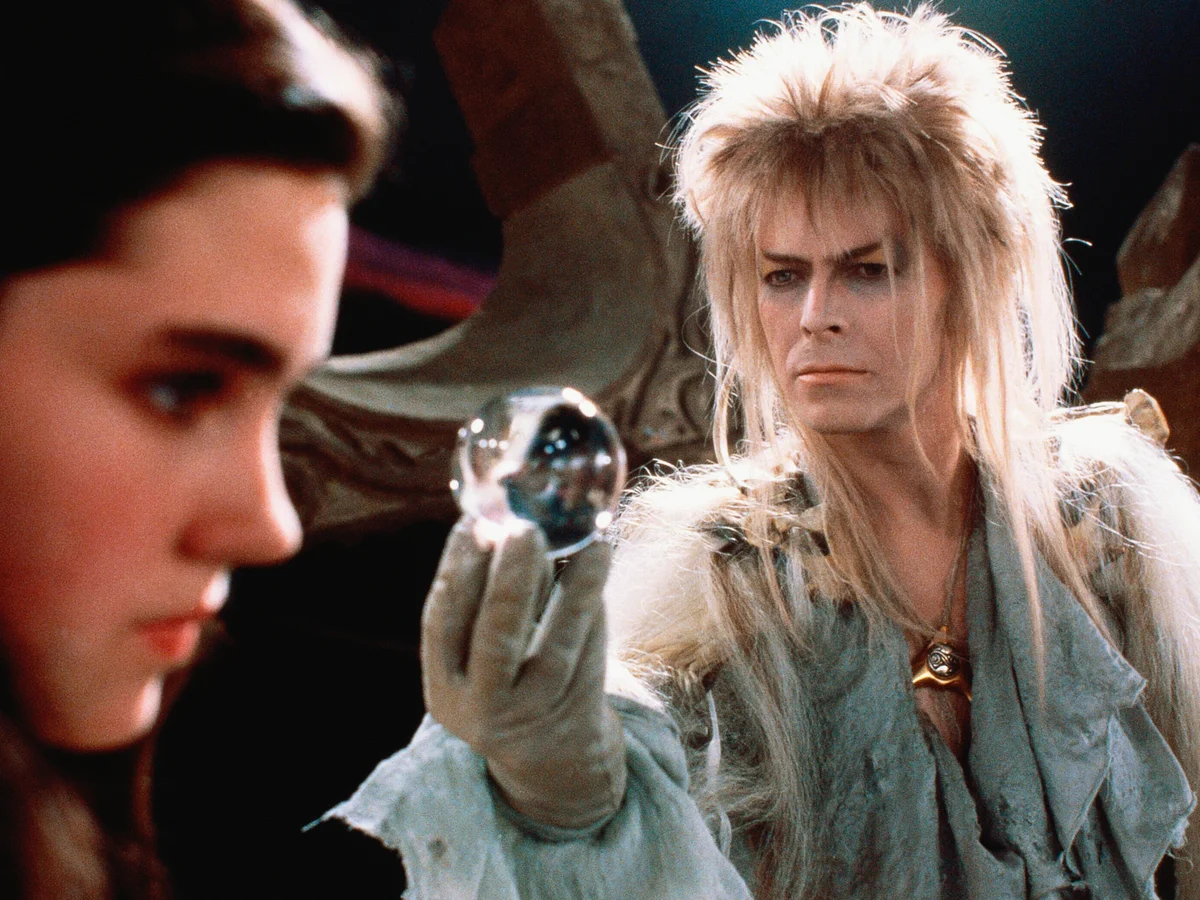
Jareth. Bowie's Goblin King in the 1986 film Labyrinth is pure theatrical charisma. He offers Sarah a world of fantasy and spectacle in exchange for her baby brother. The crystal ballroom scene is the temptation laid bare: everything beautiful, nothing real. And then that line, delivered with total sincerity: "I ask for so little. Just fear me, love me, do as I say, and I will be your slave." He is offering complete devotion. The price is your freedom. He means every word, and that is exactly what makes it terrifying. But the labyrinth is genuinely charming. The danger is real because the enchantment is real. If Jareth's world were ugly, there would be no story. Sarah would just leave.
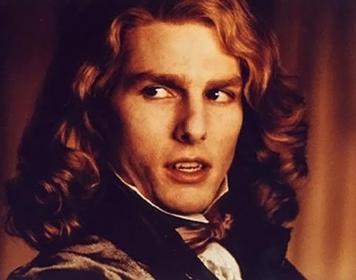
Lestat. Anne Rice's vampire is the most seductive because his love is the most physical. In her gothic horror novel from 1976, he doesn't offer Louis a kingdom or a ballroom. He offers himself: his blood, his immortality, his eternity. He transforms Louis into a vampire without real consent, because he cannot bear to be alone and because he believes, genuinely, that what he is offering is a gift. Lestat is the archetype taken to its logical conclusion. The others trap the beloved in a beautiful place. Lestat turns the beloved into what he is. You don't just stay with me forever. You become me. And Lestat is genuinely fascinating, genuinely magnetic. He is not a cautionary tale. He is the reason people read the books.
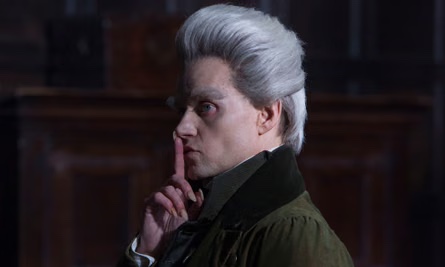
The Gentleman with the Thistledown Hair. Susanna Clarke's fairy king in Jonathan Strange & Mr Norrell is the most unsettling of the four, because he is the only one who is not cruel. He is oblivious. He enslaves Stephen Black through an excess of generosity, dragging him to an eternal ball night after night. He genuinely does not understand why Stephen would not want to dance forever. Morality does not register. He is not ignoring Stephen's wishes; he is incapable of perceiving that Stephen has wishes. The Gentleman loves Stephen the way a child loves a toy. Completely, sincerely, and without any recognition that the toy might have an inner life.
The Problem
If Plato is right, these figures should not exist. A soul that perceives beauty with such clarity should also perceive the good. Xerxes, who can sing "Ombra mai fu" with genuine feeling, should also be capable of recognizing Romilda as a person rather than an acquisition. Jareth, who builds worlds of such imaginative beauty, should also understand that beauty offered without the freedom to refuse it is a prison. Lestat, who experiences the sensory world with such intensity, should also grasp that transforming someone without their consent is a violation, not a gift.
But they don't. And the reason they are so disorienting is precisely that the beauty is not fake. It would be easy, and comfortable, if the Faery Prince's beauty were a disguise. If the ballroom were an illusion. Then we could preserve the Platonic thesis: real beauty still tracks with goodness, and what these figures offer is merely the appearance of beauty. But that's not what's happening. "Ombra mai fu" is really beautiful. The labyrinth is really charming. Lestat is really captivating. The aesthetic achievement is genuine. The moral failure is also genuine. They coexist.

This is what makes the archetype a true counterexample to Plato, and not merely an uncomfortable character type. These figures do not fail to perceive beauty. They perceive it brilliantly. They fail to perceive personhood. They have an exquisite sensitivity to order, proportion, atmosphere, and charm, and no sensitivity at all to the interior life of another human being.
One might reasonably object that Plato would point to the Faery Prince’s discord with the wider order. Plato distinguished sharply between the tyrant and the philosopher-king. The tyrant is ruled by appetite; the philosopher-king by reason. Yet if we examine the guardians in the Republic, what space is left for individual personhood? The guardians regulate marriage and reproduction for the sake of civic harmony. The individual becomes subordinate to the design of the whole. How different is this, in principle, from Xerxes assuming that Romilda may be arranged according to his vision of order? For Plato, tyranny is defined not primarily by constraint but by disorder of the soul, appetite ruling reason. But this raises a harder question: even if rule by reason produces harmony, is harmony sufficient? Is an order that sacrifices individual freedom for cosmic design truly just, or only beautiful?
Love and Free Will in the Garden of Eden
Aquinas said that to love someone is to desire their good. But how do you define good? The good you have decided, or good as they understand it? And, even if you perceive someone's place in a perfect moral order, is it right to discard their autonomy, their personhood, in order to put them there?
Jareth never asks Sarah what she wants. He tells her what she should want. Lestat never asks Louis if he wants to be immortal. He just does it, because the alternative is loneliness. Xerxes does not court Romilda; he requisitions her. In each case, the beloved has been demoted from a person to a possession. The Faery Prince possesses such a commanding vision of beauty that other people’s interiority cannot compete with it.
This is why our final destination is the Garden of Eden: a perfect moral order, yet one in which participation is voluntary. Adam and Eve remain free to depart. In Eden, order does not erase freedom. To love someone, then, is not merely to will their alignment within the moral structure of the cosmos. It is also to will their freedom, to honor their personhood even at the risk of disorder. The God of Genesis breaks from the Faery Prince archetype precisely here. He does not compel participation in perfection. He permits departure, even at the cost of the garden.
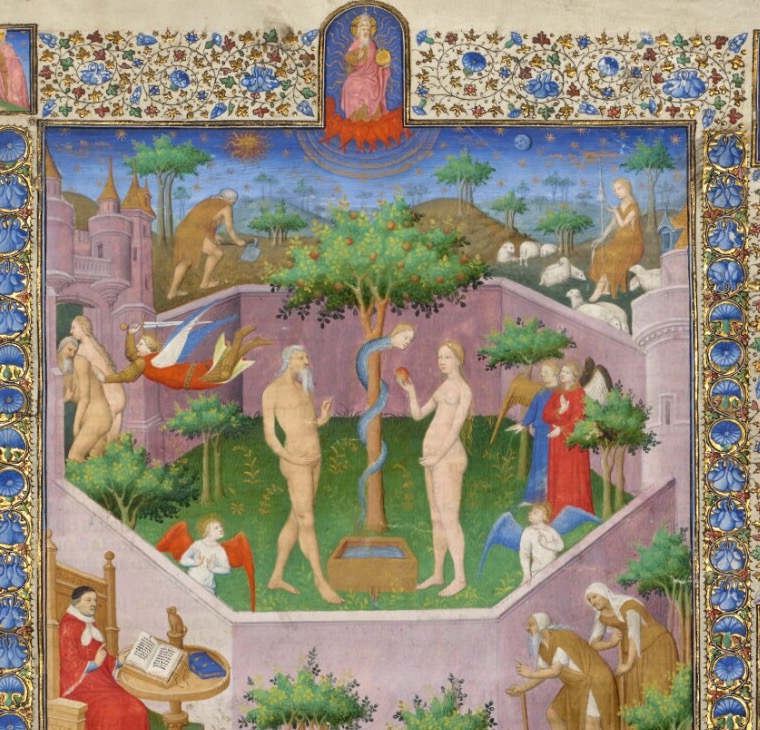
It is, if you think about it, the Biblical God's first great sacrifice for humanity: the decision to build something perfect and let it be refused. The Faery Prince would not permit this impertinence. He would rather keep you in the garden forever, dancing, adoring, unable to leave. And in this respect, paradise and gilded prison are distinguished by a single article: the door.
You might also like:
- The Key to Satisfaction in Life · Why happiness is a congruence problem, not a mood.
- Mozart's Greatest Fear · How Mozart staged his own class anxiety across three operas about powerful men and the women they pursue.
Footnotes
-
Technically a plane tree (Platanus orientalis). In English, "sycamore" and "plane" are often used interchangeably in casual discussion, though they are distinct species. The scene is drawn from Herodotus (7.31), who records that Xerxes, on his march to Sardis, came upon a plane tree so beautiful that he adorned it with gold ornaments and appointed a guardian to watch over it. ↩
-
Contemporaries agreed. Serse was a commercial disaster at its 1738 premiere, lasting only five performances before closing. Critics emphasized the absurdity of the plot and the awkward mixing of comic and serious elements. The opera disappeared from the stage for nearly two centuries before its modern revival in 1924. See Interlude, "The Dismal Failure of Handel's Opera Serse". ↩