Wicked and the Crisis of Competence
Last month, I saw Wicked. Sue me. It's not exactly aligned with my usual reading list or my reader base, but hear me out. The film itself is fine, a competent adaptation that flattens some of the source material's edge. What I want to talk about is the original novel by Gregory Maguire and the Broadway musical, which together form a painfully lucid parable about something we're all feeling right now: the slow, sickening erosion of competence in public life. The tension between aptitude and perception has become the central drama of our era, and Wicked dramatizes that with rare clarity.
We live in a culture where people fail upward through narrative gamesmanship, where access trumps ability, and story outpaces substance. That dynamic has created a kind of spiritual vertigo, especially for young people with real skill. If you can actually do the thing, you’re forced to watch as lesser talents spin empty stories, win the spotlight, and cash the check. This wasn’t the world we were raised to expect. We grew up hearing, “Don’t count your chickens before they’ve hatched.” And yet today, the currency isn’t solid outcomes from yesterday; it’s rosy promises about tomorrow.
That’s the genius of Wicked. It’s not just a glittery prequel or a tired exercise in “what if the villain had feelings too?” It’s a meditation on what happens to good, talented people as they navigate a world dominated by appearances.
The Glinda-Elphaba Dialectic
At its core, Wicked asks a simple but devastating question: How do you achieve a moral outcome in a world that rewards surface over substance?
The answer is just as devastating: you can’t do it alone, not if you want to win. To change anything, you must master both outcomes and optics. You have to manage what is, and what appears to be. And, my goodness, is that exhausting.
That insight is why Wicked resonates so deeply in this moment. Because no matter how righteous or capable you are, you will not move the needle unless you can sell your story. And that story will often cost you something: your authenticity, your privacy, your soul. This is the cost Glinda and Elphaba each reckon with. Glinda sacrifices integrity for influence; Elphaba sacrifices influence for integrity. Their divergence is the point, their reconciliation, the solution.
If I could give one piece of advice to recent grads, it would be this: perception usually wins. Not because it should. Because we’ve built a world where people take their cues from consensus and vibes, not competence.
It's the price we pay for self-determination. In a free society, where collaboration is voluntary, narrative becomes a tool of survival. You have to convince others to cooperate, and scammers will always exploit that fact more shamelessly than you.
Darwinian Scammers and the Two-Track Mind
While the question of optics vs. outcomes is topical, it isn’t new. Strip away any social commentary, and you’re still left with a basic truth about human evolution.
A prehistoric band of hunter-gatherers depended on two personas:1
- The war-chief, who commands loyalty and rallies the group.
- The shaman, who sees patterns, deciphers reality, and warns of danger.
One reads people; the other reads reality. Together, they keep the tribe alive. Most people, the rest of the tribe, don’t need to lead or interpret. They just need to follow someone they trust. And that’s fine. A tribe doesn’t scale if everyone thinks they’re the shaman, and it lacks cohesion if everyone tries to be chief. Too many cooks.
The band thrives when the shaman and the war-chief work together, and collapses when one exploits the other. That’s the dynamic at the heart of Wicked. Glinda is the charmer. Elphaba is the seer. They’re two halves of the same moral project.
I actually suspect nerds and jocks may be somehow predisposed to collaborate, though I have no proof. My hunch is this: people are impressionable and horny, which means charismatic, attractive people often get away with flouting collective norms. That dynamic gives them a strange kinship with the neurodivergent, those who couldn’t follow the norms even if they tried. They’re both operating just outside the lines.
The real tension doesn’t come from either extreme. It comes from the middle: the consensus-driven, socially conformist majority. The ones who enforce the rules they didn’t write. The normies, if you will.
On Friendship, and Fraud
This is where Wicked stops being clever and starts being honest. The film’s most poignant message is this: friendship between the competent and the charismatic isn’t just sentimental, it's powerful. Madame Morrible and the Wizard are powerful villains because they work well together.
In a world where outcomes are mediated by perception, real change only happens when nerds and jocks work together, like Morrible and the Wizard. And positive change happens when that pair has a conscience, like Glinda and Elphaba.
That’s why this isn’t just a story about fame or betrayal. It’s a story about grief. When the Glindas of the world take credit for the Elphabas, it becomes a kind of emotional theft. And when Elphabas turn bitter and withdraw, the system rots from the inside.
Actually Useful Moral Payout
What elevates Wicked is that it doesn't just lament the problem. It offers some practical life advice via two cautionary foils: the Wizard and Madame Morrible. The Wizard is Glinda’s dark mirror: charm weaponized into control, sentimentality as a substitute for conscience. Madame Morrible is Elphaba’s: intellect twisted into indifference, competence used to excuse cruelty.
For the Elphabas, the temptation is retreat, to write everyone off, to become cold and unreachable. The label of “mean, nasty witch” becomes a self-fulfilling prophecy, because authenticity alone isn’t a virtue. What's the point of being honest about who you are if who you are is a jerk?
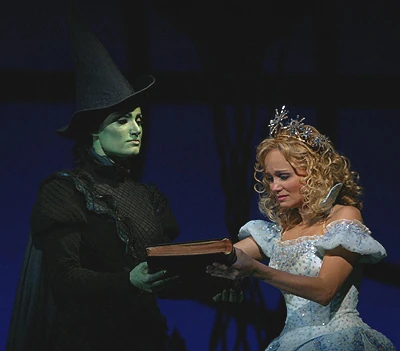
For the Glindas, the danger is delusion, mistaking applause for virtue. There’s a reality beneath perception, and it matters whether anyone believes in it or not.
So here's the actual moral payout: you need both. The seer and the charmer. The one who reads the map, and the one who gets the group moving. Either one alone is dangerous. Together, they are still fragile, but they are how anything worth doing gets done. It is not a happy ending. But it is a beginning, if you let it be.
You might also like:
- Mozart's Greatest Fear · How Mozart staged his own class anxiety across three operas about powerful men and the women they pursue.
- The Key to Satisfaction in Life · Why happiness is a congruence problem between internal values and external life.
Footnotes
-
This framing isn't my own inference, but it was shared with me by someone I deeply admire who wishes to remain anonymous. ↩