How to Make Audiobooks for Free; or, The End of Culture
Maybe a year ago, I tried my hand at turning PDFs into audiobooks. This is not a trivial task; PDF scans are a mess of characters a narrator isn't supposed to recite. You have to turn a book into a script. If you manage that, you have to use some form of text-to-speech that is stable, clear, expressive, and does aesthetic justice to the text.
A year ago this did not work. LLMs were not reliable enough to scrub the PDFs into pristine scripts; text-to-speech was still too inconsistent to reliably produce mellifluous oratory. Beyond this, it was cost prohibitive. The choices of LLM were Anthropic and OpenAI, and commercial API pricing for scrubbing a single book ran something like five hundred dollars. You can buy most books for such a price. It wasn't worth it.
Today, this pretty much just works. Anyone with a chip can throw a free LLM at a PDF and get a good script; open-source voice-cloning models can produce realistic, prosodic narration in any voice of your choice. I have cheesed this to a great deal, and have conscripted numerous dead celebrities to narrate my favorite books. Please enjoy the dulcet tones of Dylan Thomas narrating The Velveteen Rabbit, courtesy of my own pdf2audiobook utility:
Turning a book into a script
PDF scans are messy and contain a menagerie of orthography that should never make it into an audiobook: footnotes, chapter headings, page numbers. Frequently and perhaps strangely, many books include the title of the book as a header on every other page, as though the reader might forget. I suppose this must be some kind of billboard for shoulder surfers. This too must be cleansed from the audiobook script.
If you pull this off and have a clean script for your narrator, you still have to solve pronunciation. You don't want the narrator to pronounce the War of 1812 as the War of One Thousand Eight Hundred and Twelve. Your pipeline has to flag this and know it's a year and should be pronounced "eighteen-twelve." Many such cases.
The novelty wore off after the first several books, and I set out to build my next Tower of Babel: PDF to film. Dump in text; get a movie out. Text-to-video models like Wan have made enormous leaps in the last few years. My Instagram feed often features genuinely beautiful, coherent, AI-generated reels, from accounts like Gossip Goblin, Delphi Motion Pictures, and gloomstomper. I know it can be done. I know people are doing it. Obviously, I must now figure out how to bring the under-appreciated works of world literature to the silver screen, from the comfort of home, of course.
Turning a book into a film
It doesn't work today. I tried doing a simple frame-by-frame storybook narration on the Odyssey. The best free, open-source models can't reliably produce an image of a blinded cyclops, let alone one with scene and character continuity. I was curious how the Instagram accounts are doing it, and came across this article. Gossip Goblin, probably the best at this, spends about two working days on a three-minute film, and to go longer he had to raise money and hire a team of eight. It's just not there yet.
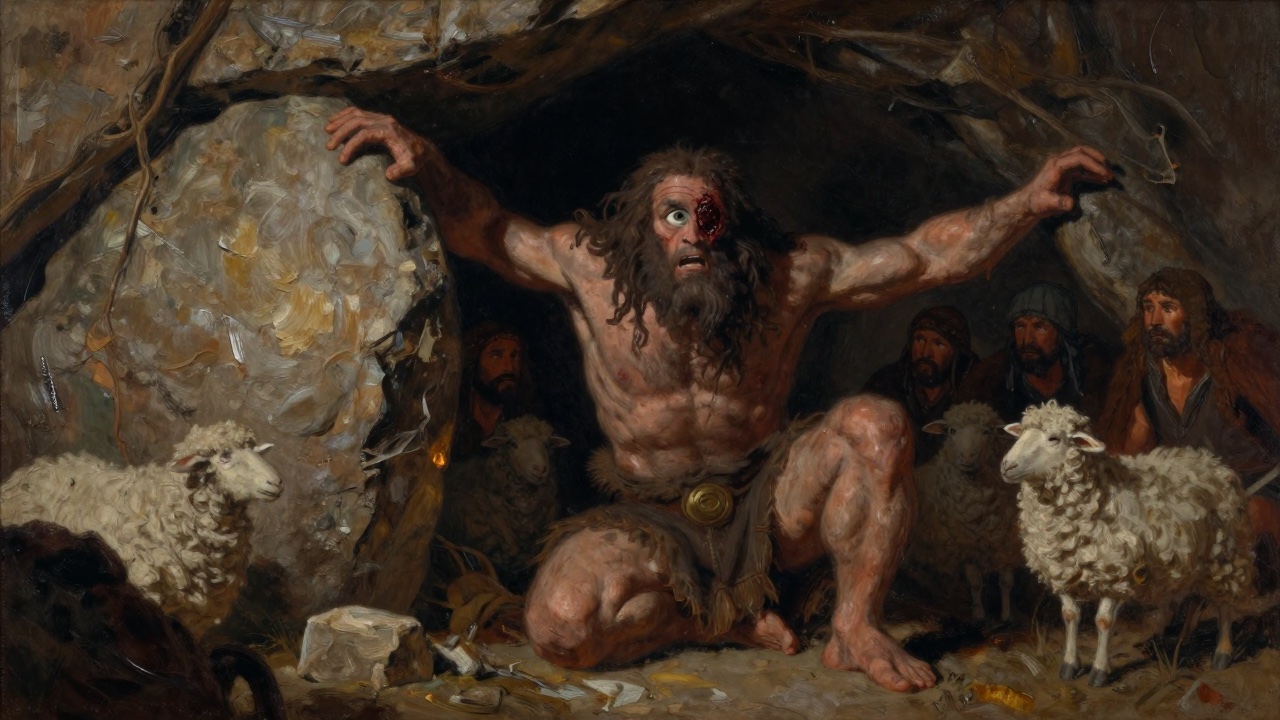
But I have a strong suspicion that, just like audiobooks, AI video generation will simply work in a few years. What does this mean? It means we are going to live through the greatest democratization, and therefore fragmentation, that has ever transpired in human history. Most cultural production is constrained to elite taste and sensibility or to the utmost proletarian slop, the lowest common denominator. Modern culture balances the dichotomy of the highest luxury and low-effort garbage. This paradigm will now collapse in the face of an infinitely expanding middle: a global army of individual artists unconstrained by the logistical costs of production.
This will fundamentally change culture. Not just our current culture, but what "culture" even means. It will be something like what's happened to music in the last half century: democratization and hyper-differentiation. For $15 a month, Spotify offers you the sum of all human musical achievement: Brazilian bossa nova, Salieri's operas, Chicago, Hildegard von Bingen. A hundred years ago, hearing Salieri would have been a once-in-a-decade opportunity for a pretty wealthy person already deeply following opera. I listened to Axur, re d'Ormus on an airplane.
Something like this will happen to TV and film, even more than it already has with things like YouTube. Your favorite TV shows will be on some small creative team’s YouTube channel. You can watch a totally beautiful but completely accurate dramatization of the precise events of the First Crusade. You can feed your Facebook feed to Claude and watch a movie about your time in high school (if you hate yourself). It will expand our entire notion of genre, and perhaps of what film is even for.
And I think this will transform and potentially decohere society, more than it already is. No one will have any shared cultural touchpoints, the same way no one listens to the same music. Culture won’t scale much beyond hobbyist demographics (see podcasts), and will increasingly operate at the scale of a social circle: book clubs, networking groups, churches, and so on.
The few thousand years of human culture look something like an accelerating aggregation. Tribal cults evolving into universalist religions; multilingual communities writing in a shared literary language. Actual biological ties of tribe and kinship suppressed in favor of constructed identities like nation, ethnicity, or civilization. Tricking humans into thinking they have something in common with millions of people they’ve never met. In the age of globalism, we might say aggregation has finally become assimilation.
The clock runs out for this arc of history in about three years.