Peace on Earth and the Shepherding of Mankind? A Syriac Reading of Luke 2:14
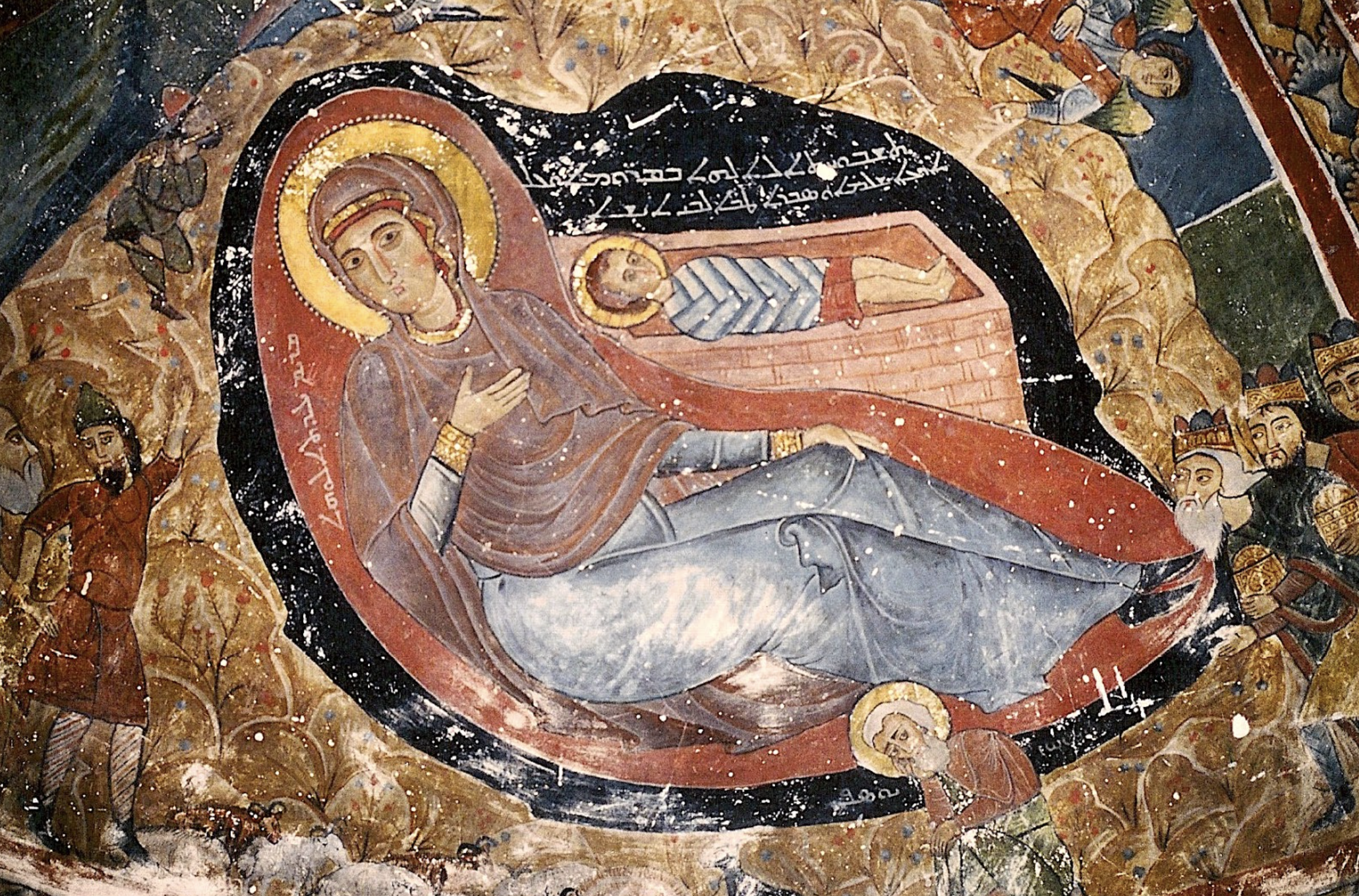
As we enter this festive time of year, we recall the angels' announcement to the shepherds: "Glory to God in the highest, and on earth peace, good will toward men." At least, that is how the King James Version renders it. Modern translations read differently: "and on earth peace among those whom he favors." The difference turns on a single Greek letter. But the Syriac evidence suggests that both readings may miss something from the original Aramaic.
The Greek Problem
The Greek manuscripts of Luke 2:14 divide over the final word of the phrase. Is it εὐδοκία (nominative) or εὐδοκίας (genitive)? One added sigma changes the grammar entirely.
The Textus Receptus, followed by the King James Version, reads:
καὶ ἐπὶ γῆς εἰρήνη ἐν ἀνθρώποις εὐδοκία
Here εὐδοκία stands as a second subject alongside “peace.” The angels announce two parallel goods: peace on earth, and goodwill toward humanity.
Modern critical editions follow a different reading:
καὶ ἐπὶ γῆς εἰρήνη ἐν ἀνθρώποις εὐδοκίας
With εὐδοκίας in the genitive, “peace” is restricted to a specific group: peace among those who are objects of divine favor.
The manuscript evidence favors the genitive reading. It appears in Sinaiticus, Vaticanus, and Alexandrinus. The nominative survived primarily in the later Byzantine tradition. Why, then, did this confusion arise at all?
The Syriac Witness
The Old Syriac Curetonian manuscript1 reads:
ܫܠܡܐ ܒܐܪܥܐ ܘܐܪܥܘܬܐ ܠܒܢܝܢܫܐ
shlama b-ar‘a w-ar‘uta l-bnaynasha
“Peace on earth and ar‘uta for mankind.”
That middle word, ܐܪܥܘܬܐ (ar'uta), is unusual. It does not appear in R. Payne Smith's Thesaurus Syriacus (1879), the standard Syriac lexicon, and it is likely Diatessaronic in origin. Jan Joosten has suggested that it reflects a Western Aramaic form related to rə'u ("favor, pleasure"), making it a reasonable semantic match for Greek εὐδοκία.2
But there is another possibility, one with much richer implications.
A Pastoral Root
The Syriac root ܪܥܐ (r‘a) is extremely well attested across Semitic languages. It carries two tightly linked semantic fields:
- Pastoral: to graze, tend, shepherd
- Relational: to please, pacify, reconcile
In Syriac, the Aphel form ܐܪܥܝ (ar‘i) means “to appease, pacify, make peace.” The more common nominal form for shepherding is ܪܥܝܘܬܐ (r‘ayuta), but Syriac is a famously productive language. Unattested or rare formations are not unusual, even for loanwords.
Under this reading, ar‘uta could mean something like pacification, reconciliation, or even shepherding, with all the pastoral overtones the root carries.
This semantic overlap is ancient. The shepherd as comforter, guide, and pacifier appears in Akkadian rē’ûm, Arabic ra‘ā, and Hebrew scripture. Psalm 23 is only the most famous example. Across the ancient Near East, the shepherd is the one who calms, protects, and orders the flock. The root has a rich history of crossing over from literal into abstract semantics.
The Wordplay
Now consider the immediate context.
The angels appear to shepherds. In Syriac, “shepherds” is ܪ̈ܥܘܬܐ (ra‘awata), the plural of ܪܥܝܐ (ra‘ya).
Compare the two words:
- ra‘awata (shepherds)
- ar‘uta (shepherding / pacification)
In Syriac, they differ by a single letter. Written, they are nearly identical. The angels announce to the ra‘awata the ar‘uta of mankind.
“Peace on earth and the shepherding of humanity,” proclaimed to shepherds.
This looks very much like deliberate literary wordplay, whether homophonic or near-homographic. It is elegant, contextual, and theologically dense. And it is completely invisible in Greek.
Greek εὐδοκία captures the relational sense of favor or goodwill, but it has no connection to ποιμήν (shepherd). A Greek reader would never perceive the pun.
A Familiar Gospel Pattern
There is a striking parallel elsewhere in the Gospels. In Mark and Matthew, Jesus tells fishermen that he will make them fishers of men. Their profession becomes the metaphor for their mission.
Here in Luke, the angels announce to shepherds that the Messiah will shepherd humanity.
The pattern is the same. The audience’s labor becomes the image for the cosmic work being revealed.
What Happened in the Peshitta
The passage just examined derives from the Old Syriac manuscript tradition rather than from the standard Syriac text, the Peshitta, which is widely used in the Middle East today. The Peshitta reads instead:
ܫܠܡܐ ܥܠ ܐܪܥܐ ܘܣܒܪܐ ܛܒܐ ܠܒܢܝܢܫܐ
shlama ‘al ar‘a w-sabra taba l-bnaynasha
“Peace on earth and great hope for mankind.”
ܣܒܪܐ (sabra) means “hope,” “expectation," and sometimes "thought." It is closely related to ܣܒܪܬܐ (sbarta), the common native Syriac word for “gospel” or "good tidings." As an interpretation of εὐδοκία, it makes sense.
But it is not the same word.
The Peshitta translators may have found ar‘uta awkward or unfamiliar, or insufficiently aligned with the Greek manuscript tradition, at a time when there was a desire to harmonize biblical renderings across languages.
They may also have been drawing on scribal traditions parallel to the Greek text rather than consciously imitating it. In doing so, they produced a version that aligned cleanly with other biblical translations, but at the cost of idiomatic Syriac and the pastoral wordplay that made the Curetonian reading so contextually and literarily apt.
Transmission and Loss
One possible reconstruction:
- An original Aramaic formula used a word from r‘a, carrying both favor and shepherding overtones
- Greek translators rendered this as εὐδοκία, preserving meaning but losing wordplay
- Greek scribes struggled to construe the phrase grammatically, producing nominative and genitive variants
- The Old Syriac Curetonian preserved or recovered the Aramaic word
- The Peshitta normalized the phrase, trading resonance for harmony with the Greek.
Why This Matters
This is not an argument for Aramaic Gospel originals. But it does suggest that certain formulaic sayings, especially liturgical ones like the angelic proclamation, may preserve an Aramaic substrate that Greek transmission flattened.
Luke 2:14 is not an isolated case. Scholars have long noted that Luke’s infancy narrative (Luke 1–2) is unusually dense with Semitic features. The Greek is often polished, even elegant, yet threaded through with constructions, rhythms, and turns of phrase that feel translated rather than composed. The Magnificat, the Benedictus, the angelic announcements, and the canticles more broadly all display Hebraisms and Aramaisms that stand apart from Luke’s usual style elsewhere in the Gospel.
This material is commonly attributed to what scholars call Special L: traditions unique to Luke, largely concentrated in the infancy narrative.3 The central question has never been whether Luke could write good Greek. He clearly could. The question is whether, in these chapters, he is imitating Septuagintal style for effect, or whether he is translating or adapting preexisting Semitic material: hymns, liturgical formulas, or oral traditions already shaped in Aramaic.
The proposed ra‘awata / ar‘uta wordplay strongly favors the latter. A Greek author consciously imitating Semitic style would not generate a pun that only works in Aramaic and disappears entirely in Greek. What we see here looks less like stylistic pastiche and more like residue: the trace of a saying whose theology was carried not only by meaning, but by sound.
The textual instability in Greek points in the same direction. The nominative and genitive readings of εὐδοκία may not reflect simple scribal error so much as uncertainty about how to construe a phrase that did not originate in Greek. The Syriac divergences tell a parallel story. The Old Syriac Curetonian preserves a rare and contextually resonant term. The Peshitta smooths it into something clearer, more orthodox, and more easily harmonized across languages, but at the cost of idiomatic Syriac and literary precision.
In this light, Luke 2:14 begins to look like a translation problem rather than a doctrinal one. The angels’ announcement may originally have proclaimed not “goodwill” in the abstract, nor peace restricted to a favored subset, but peace on earth and the shepherding of humanity, announced, fittingly, to shepherds.
If so, the Curetonian reading preserves something both the Greek manuscripts and the Peshitta lost: not a theological novelty, but a literary one. A compact Aramaic wordplay that binds audience, imagery, and message into a single utterance. Not incidental. Not accidental. But the mark of a tradition that began in Aramaic, where theology could be carried in sound as much as in sense.
You might also like:
- The Memory of Rome in Coptic Christianity · How Egyptian Christians reconstituted the Roman Empire as a living spiritual reality.
- The Legend of Odisho · What an Assyrian folk hero reveals about honor cultures and the Aramaic-speaking world.
- The Secret Religion · A tour of esoteric traditions hidden in plain sight across millennia.
Footnotes
-
F. Crawford Burkitt, Evangelion da-Mepharreshe: The Curetonian Version of the Four Gospels (Cambridge: University Press, 1904), 252. Available at Internet Archive. ↩
-
Jan Joosten, "The Old Syriac Text of Luke 2:14," Novum Testamentum 34.2 (1992): 136–143. ↩
-
For Semitisms in Luke's infancy narrative, see Raymond E. Brown, The Birth of the Messiah (New York: Doubleday, 1977), 346–355; and Joseph A. Fitzmyer, The Gospel According to Luke I–IX (Anchor Bible 28; New York: Doubleday, 1981), 309–316. ↩