Was Jesus Famous? Syrians Weigh In
Nearly everything we're told about the historical Jesus comes through Greek and Latin sources: the gospels, the letters of Paul, a few brief mentions in Josephus and Tacitus. Or at least that's how the dominant academic narrative goes. The method leans hard on this material: the letters of Paul get dated first on internal linguistic evidence (which academia tends to emphasize, and perhaps overanalyze), and then there's a lot of hemming and hawing about gospel authorship, usually landing in the late first century.
Out of this comes the standard picture: Jesus was historically obscure, maybe a minor political dissident, but by no means a major figure, and his life and teachings were transmitted for the first few generations through the oral traditions of small, marginal Christian communities. Whatever fame he has, he acquired posthumously.
I challenge this. There is a plausible reading of the historical source material that says Jesus was a regional celebrity in first century Syria. His execution was political news; his movement attracted the attention of regional rulers; and his followers established communities that were already well entrenched by the second century AD. My basis for this lies in a close reading of Syriac Aramaic sources1 that most scholars discount in favor of the Greek and Latin material. But take them together with the archaeological evidence and a fairly compelling picture emerges.
Before we begin, I do have an axe to grind here, but it’s not a theological one. My bias is far more refined. I love Syriac. I am an ardent Syriacophile. A Syromaniac, even! And I do irrationally resent academics, particularly in religious studies, who have sailed through their careers without having to learn it.

An artist's impression of the author. AI-generated, but emotionally accurate.
The Evidence
There are three literary and archaeological traditions from the classical Syriac world worth examining here:
- The letter of Mara bar Serapion (c. AD 73), in which a Syrian aristocrat from Samosata treats Jesus as a figure of Socratic stature, within living memory of his ministry and execution.
- The Abgar-Tiberius correspondence (c. AD 37) preserved in the Doctrine of Addai, which suggests that a client king on the Roman-Parthian frontier was politically aware of Jesus' movement during his lifetime, and had strategic reasons to care.
- The early record of Christianity in Syria, where Bardaisan, the Chronicle of Edessa, and Abgarid coinage all point to a Christian community well established in elite circles by the second century AD and plausibly founded in the mid-first.
Mara bar Serapion
Sometime in the first century AD, a Syriac-speaking intellectual named Mara bar Serapion wrote a letter to his son from captivity. Mara was an aristocrat from Samosata. When Rome annexed the kingdom of Commagene, a small nation in northern Syria, in AD 72, Mara was among the local elites taken prisoner, carried off from his city likely never to see his son again. The letter is a father's parting consolation, and its central message is that wisdom and virtue outlast political persecution.
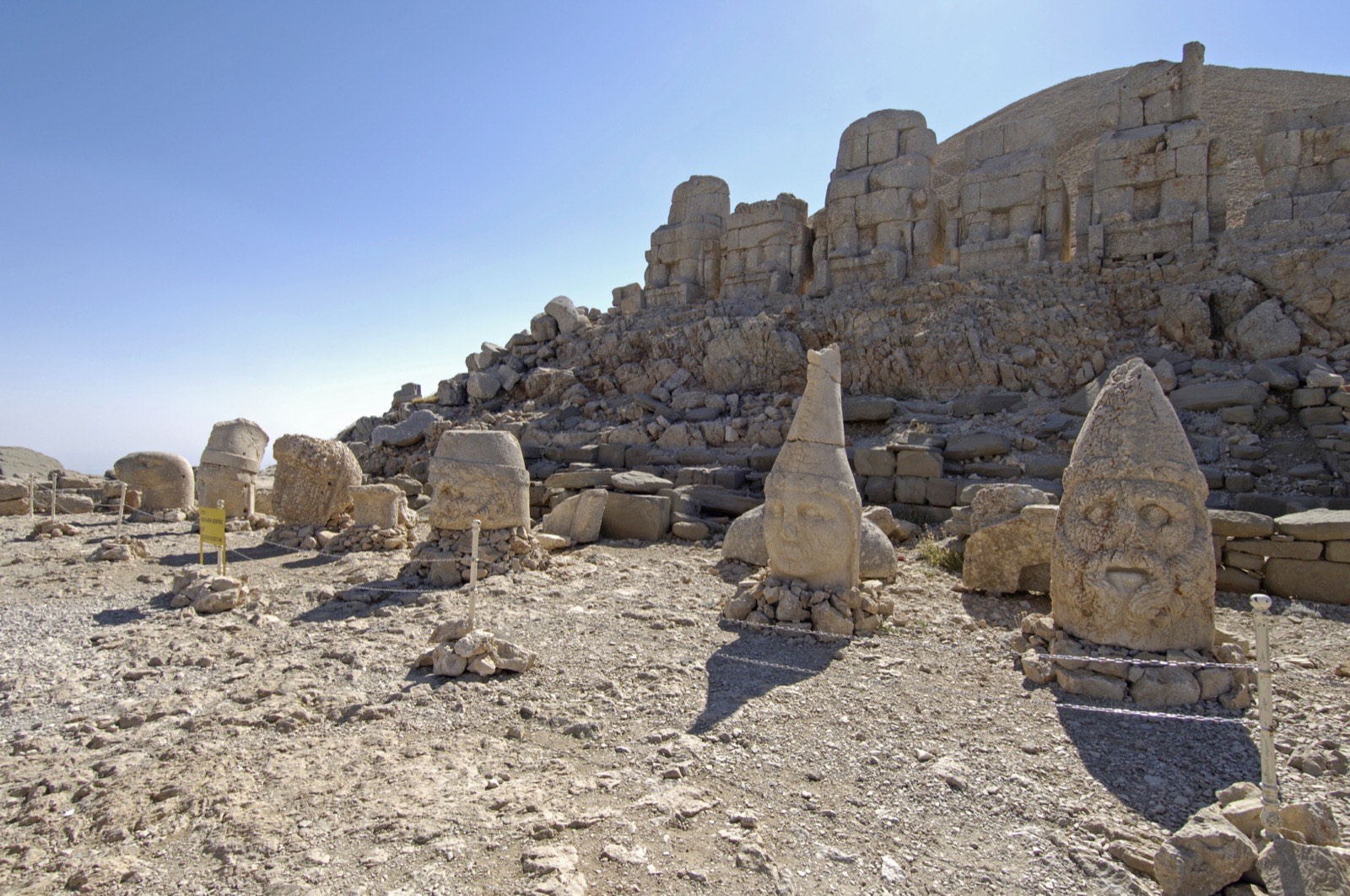
The colossal heads of Mount Nemrut, the mountaintop sanctuary of the kings of Commagene, Mara's homeland. Rome annexed the kingdom in AD 72. Photo: Dosseman (CC BY-SA 4.0).
In the course of this argument, Mara offers three examples of wise men whose killers were punished:
For what advantage did the Athenians gain by the murder of Socrates, the recompense of which they received in famine and pestilence? Or the people of Samos by the burning of Pythagoras, because in one hour their country was entirely covered with sand? Or the Jews by the death of their wise king, because from that same time their kingdom was taken away? ... Socrates is not dead, because of Plato; neither Pythagoras, because of the statue of Juno; nor the Wise King, because of the laws which he promulgated.2
There's general consensus that the "wise king of the Jews" is Jesus.3 But Mara does not name him. He names Socrates. He names Pythagoras. The third figure, the one whose unjust execution leads to the destruction of the Jewish nation, he leaves unnamed.4
Most of the scholarship on Mara concerns the dating question and whether the "wise king" really is Jesus. My interest is a bit different. I think the interesting question is not who Mara is talking about but why he won't say the name. He is being deliberately coy, and he is being coy because there is something sensitive about Jesus that makes Mara not want to name-drop him.
I think this is best understood as a kind of Straussian omission. Leo Strauss argued in Persecution and the Art of Writing that authors under social pressure encode their most dangerous ideas indirectly, through what they conspicuously don't say. The writer is most evasive about the thing that would cost him the most.
The coyness would have come naturally to Mara. His letter is steeped in Plato, the very author on whom Strauss built the theory, and Platonic idiom was wildly in vogue in classical Syria.5 Mara's takes on Socrates are completely uncontroversial. Then he sneaks in a hot take about Jesus.
Mara's hesitation makes sense if discussing Jesus was politically sensitive. The majority of scholars date the letter to shortly after AD 73, tied to the Roman annexation of Commagene. The alternative late date is c. AD 260, connected to the Sassanian capture of Samosata in the 250s.6 But by AD 260, Christianity in Syria was out in the open. Paul of Samosata, from Mara's own city, was simultaneously Bishop of Antioch and a secular government official. Public church councils met without interference. The Chronicle of Arbela, admittedly a source of debated reliability, counts more than twenty bishoprics along the Tigris by AD 224. A Syrian intellectual writing in that environment would have had no reason to hide Christian sympathies behind circumlocution. The evasiveness is out of place in the third century. In the first, it makes complete sense.
And why "wise king" rather than a name? Because anyone familiar with Christianity, then or now, instantly gets the reference. A first-century Roman official, on the other hand, could be told it meant someone else entirely. The Romans respected Judaism as an exotic, ancient tradition. Some educated Romans even knew of its headline figures, Moses and Solomon, as lawgivers, but otherwise they were extremely fuzzy on the details. Mara could simply say he'd been musing on some school of exotic oriental wisdom from his studies, perfectly normal fare for a Syrian elite of his day. Mara's ambiguity is his alibi.
So if we follow this interpretation, we see an educated Syrian aristocrat, well versed in Greek philosophy, ranking Jesus alongside Socrates within living memory of Jesus' own ministry. That is not an obscure Galilean peasant. That is a celebrity: a man whose execution was common knowledge hundreds of miles from Jerusalem, whose laws were recognized as his enduring legacy, whose death was understood to have had political consequences for an entire nation.
Abgar and the Politics of Jesus
Mara is evidence that Jesus' fame reached northern Syria within a generation of his lifetime. But there's evidence it happened even earlier. A first-century king named Abgar V, ruler of a tiny kingdom in northern Syria, is alleged to have written to the Roman Emperor about Jesus around AD 37.
The letter survives inside the Doctrine of Addai, a legend that is, on its face, spurious: Jesus and Abgar exchange letters; Abgar sends his court painter to capture Jesus' portrait; disciples arrive in Edessa and perform miracles. And when the Romans crucify Jesus, Abgar writes to the Emperor criticizing the whole affair. It feels like Christian fabrication, top to bottom.
However, Ilaria Ramelli, a serious scholar of Syriac Christianity, has argued that Abgar's diplomatic letter to the Emperor is authentic, and that the rest of the legend was constructed around it. In a meticulous 77-page study, she argues this primarily from the letter's internal evidence: names, people, and events that match first-century conditions a little too well for a forgery. On that evidence she dates it to around AD 37, a few years after the crucifixion.7
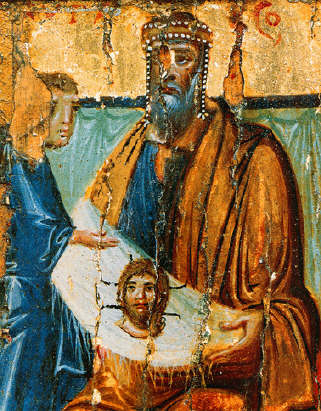
King Abgar V holding the Image of Edessa, from a 10th-century icon at Saint Catherine's Monastery, Sinai. Later legend gave Abgar's interest in Jesus a miraculous gloss.
Ramelli's case rests on the letter's internal evidence. I think the external circumstances are just as fascinating. Let's say she's right and it's AD 37. Abgar writes the Emperor a letter about the crucifixion of Jesus, which is old news at this point (AD 30-33). What is recent news is the firing of Pontius Pilate for massacring a crowd of Samaritans. Abgar doesn't mention that directly. Instead he says, in effect: "I was so furious when Jesus was crucified that I almost marched my army in, but of course I would never do that, because I respect the Roman Empire and our sacred borders."8
The reference to Jesus is political, not theological. It points straight at Pilate's recent mishandling of the Jews and Samaritans. Pilate was a Roman governor imposed on an area traditionally ruled through client kings (remember King Herod from the Bible?). Abgar is pointing out that the arrangement didn't work: the Samaritan massacre was merely the last straw in a long list of the governor's political miscalculations, going back to the crucifixion.
The framing quietly accomplishes a few things for Abgar. Without ever saying it directly, he's telling the Romans:
- One: direct rule doesn't work in the Middle East. You saw what happened in Judea. You need client kings, client kings just like me.
- Two: whatever you may have heard, my troops don't cross Roman borders.
- Three: I do have troops, though. And I'm right next door, so I'm better off as your friend.
Abgar is telling Rome: I'm useful and friendly. Why would he want to tell them this specifically in AD 37?
We need to back up a second. Abgar's kingdom, Osroene, was sandwiched between two rival superpowers: Rome and Parthia (roughly, modern Iran). Between the two empires ran a belt of small client kingdoms, and Judea, the belt's perpetual flashpoint, was among them.9 Abgar ruled his from the city of Edessa, sitting directly on the main river crossing between the two worlds.
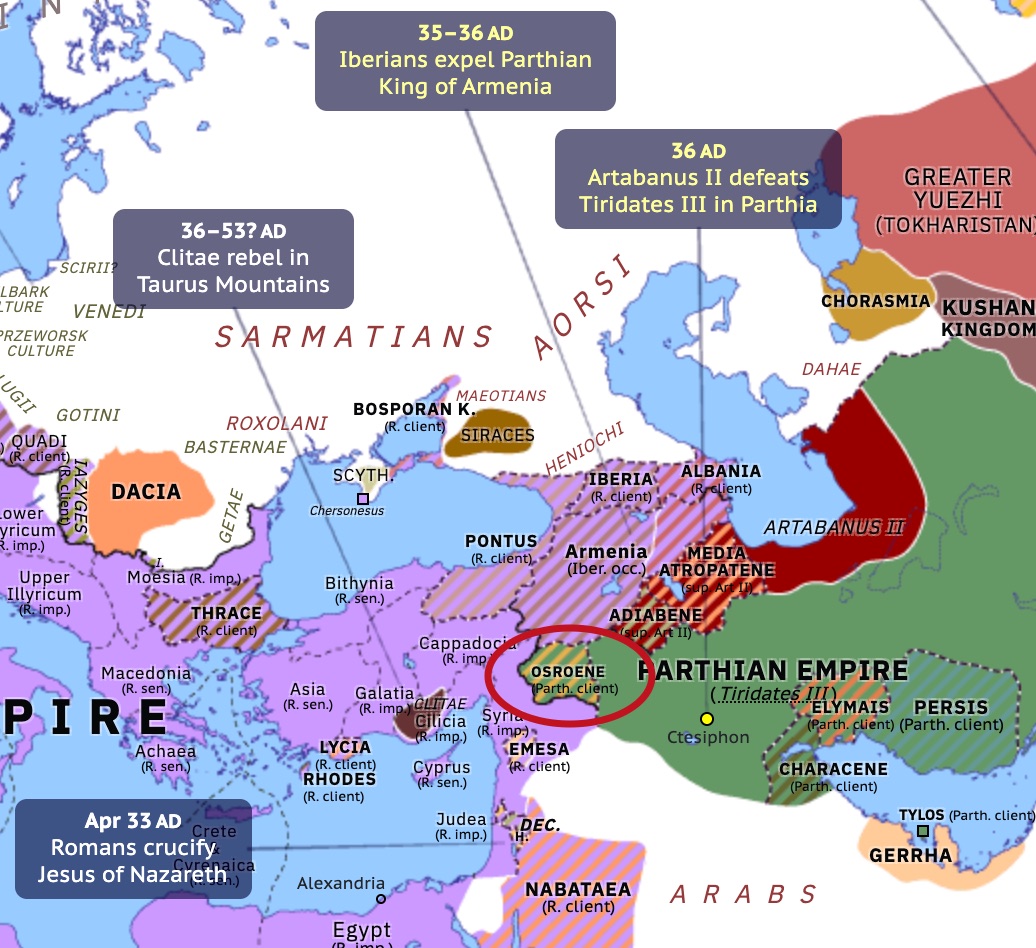
Osroene (circled in red) in AD 36, wedged in the seam between Rome (purple) and Parthia (green). Note the bottom-left callout: the crucifixion shares the map with a Parthian civil war; more on that shortly. Detail from Omniatlas (cropped, circle added), licensed under the Creative Commons Attribution-NonCommercial 3.0 New Zealand Licence.
These client kings balanced a few standing priorities. One: stay friendly with both sides; align with one, but don't annoy the other too much. Two: stay independent; both empires had a habit of annexing client states, so don't let either get strong or angry enough to swallow you. Three: at all costs, avoid having Rome and Parthia fight a war in your backyard. Abgar and his dynasty were masters of this tradition.10
In the years leading up to Abgar's letter (the mid-30s AD), everything exploded. Parthia tried to take over Armenia, Abgar's northern neighbor. Parthian nobles, possibly linked to Abgar's court, then schemed with Rome to replace the Parthian king, tipping Parthia into civil war (that's the red Artabanus faction you see in the map).11 Rome marched an army to Abgar's border, escorting its own candidate for the Parthian throne. Then, conveniently for Abgar, a war broke out to the south, pulling Rome's legions away toward what is now Jordan; later chroniclers allege Abgar secretly helped fuel it, though we can't know for sure.12 And in late 36, Rome fired its governor of Judea, Pontius Pilate, for massacring a crowd of Samaritans who had followed a new prophet.11
This backdrop says a lot about the letter. Rome is wondering where Abgar will land in the Parthian civil war: is he with us or not? And there is evidence the Romans suspected him of meddling in the Jordanian crisis.12 The letter manages to address both concerns without directly referencing either crisis.
When Abgar says he wanted to avenge the crucifixion but held back out of respect for Roman borders, he's answering the whisper about Judea and Jordan. Did he meddle? Absolutely not! He would never! And when the letter dwells on the sacred peace treaty and the borders between Rome and Osroene, he's answering the other question, the one the Romans really want his opinion on: I'm neutral in the Parthian civil war, and since I respect your borders so much, please don't march troops through mine.
And this is why I think Ramelli is onto something. Beyond her internal evidence, there is an elaborate political logic to Abgar's letter, and every piece of it works in the context of AD 37. If she's right, then we have a second Syriac source, nearly forty years before Mara, in which a local king brings up Jesus' execution to the Roman Emperor with zero explanation, fully confident the Emperor will know exactly what he means. You cannot make diplomatic small talk out of an obscurity. For the letter to work at all, Jesus had to be famous, in connection with the political mess in Judea, of course, but famous. And in Edessa, the story did not just pass through. It stayed.
How Deep Does Edessene Christianity Run?
The last piece worth noting is just how early Christianity establishes itself in Edessa, Abgar's capital. Setting aside Mara's letter, the earliest surviving Syriac literary text is the Book of the Laws of the Countries, composed by Philip, a student of the philosopher Bardaisan, sometime between AD 196 and 222. In it, Bardaisan mentions the conversion of a King Abgar in passing:
In Syria and in Edessa men used to castrate themselves in honour of the goddess Tharatha; but when King Abgar became a believer, he commanded that every one that did so should have his hand cut off, and from that day until now no one does so in the country of Edessa.13
Which Abgar? Osroene had a lot of kings named Abgar. Most scholars say Abgar VIII "the Great," who reigned from AD 177 to 212 and was Bardaisan's own contemporary. I personally suspect it was an earlier one. Bardaisan treats the conversion as established past fact, the kind of thing that has already settled into local memory. That is a strange way to describe the recent religious awakening of the king you have dinner with.
That said, coins jointly minted with the Roman Emperor Commodus show Abgar VIII wearing a tiara ornamented with what appears to be a cross.14 This is debated; numismatic identification of Christian symbols on pre-Constantinian coinage is always contested. The CNG catalogue description records the tiara as "ornamented with +," though the same catalogue calls the Christian reading of that symbol "wishful."15 Notably, these coins are paired with Commodus (r. AD 177-192), which would place the cross symbol even earlier than the c. AD 201 conversion date usually given.
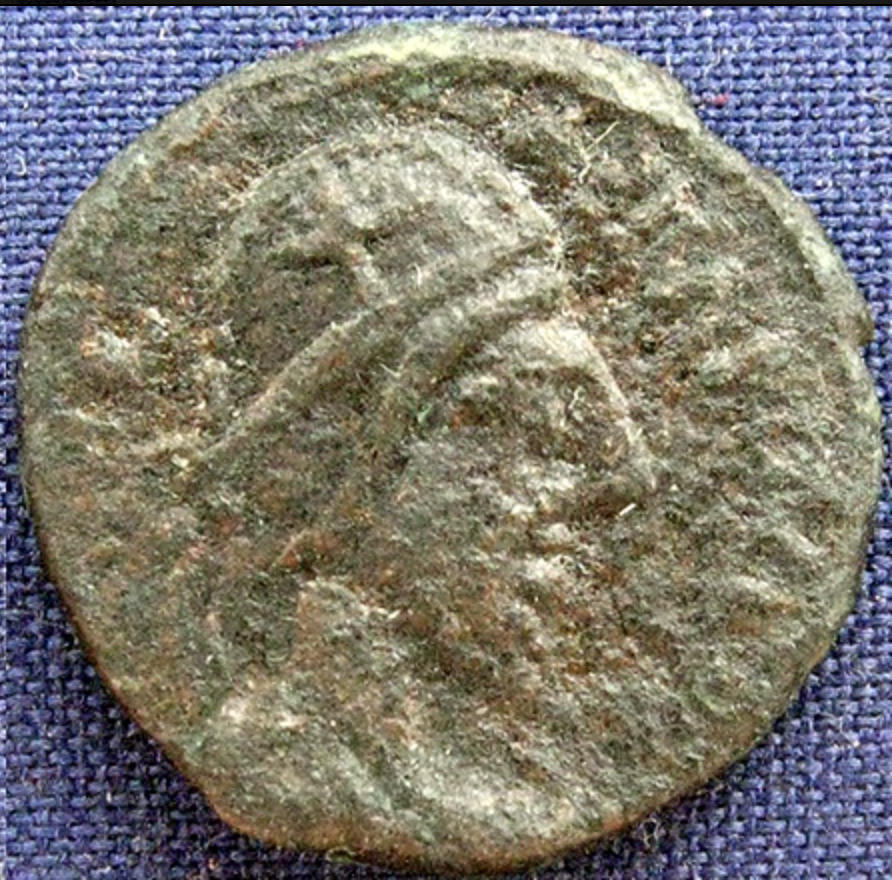
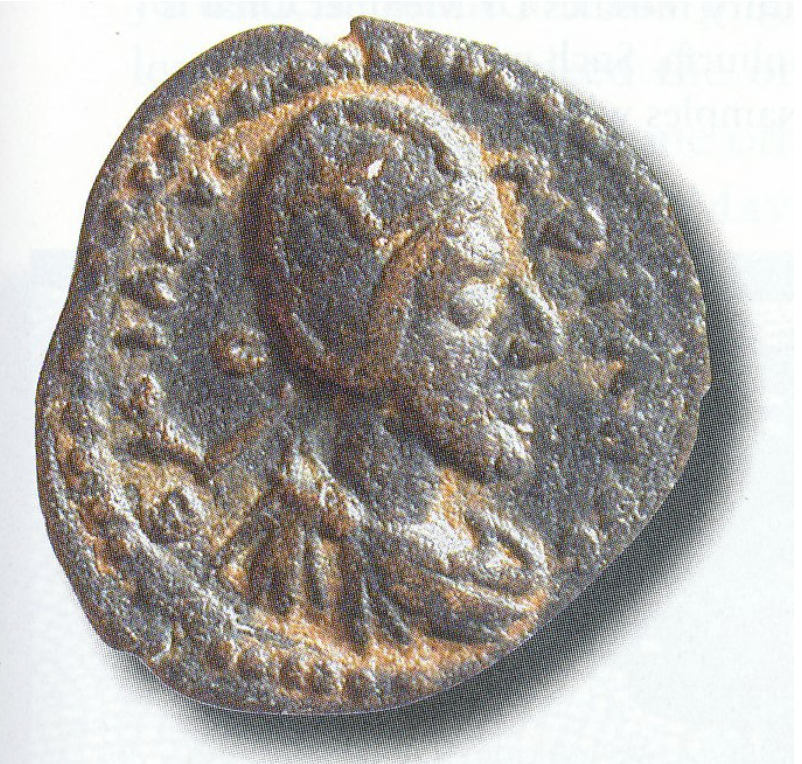
Bronze coins of Abgar VIII (r. AD 177-212) jointly minted with Commodus. The cross on the royal tiara is visible at the apex of the headgear. Left: VCoins, 2016. Right: Wilson, The Shroud (2010), plate 15a.
Now, a caveat is warranted here. To my knowledge, no academic numismatist has published conclusively on whether these symbols are Christian crosses, and the identification has so far been advanced primarily by popular rather than scholarly sources.16 But look at them. They're clearly crosses. This is not a case of squinting at scratches on a rock and calling it proto-Sinaitic, particularly given that other Edessene royal coins from the period feature cross-hatched patterns or astronomical symbols on their diadems instead. And the real weight of the argument does not rest on the coins alone. Bardaisan already tells us an Abgar converted. The coins simply make it harder to argue he was making it up.
Then there is the Chronicle of Edessa, composed around AD 540-550 from old royal archives. Its entry for November AD 201 records a major flood of the river Daysan that damaged several buildings, including "the church of the Christians." There is no conversion narrative, no founding legend, no dramatic moment of Christianization. The church is mentioned the way you mention a bridge or a market: it's just there, part of the cityscape, unremarkable.17
Any one of these data points could be contested individually, but they converge. Bardaisan treats the conversion as old news by c. AD 200. The Chronicle mentions a church in AD 201 as just another building. The coins put crosses on a royal tiara in the 180s. None of this proves there were Christians in Edessa in the 30s or 40s. It proves something more defensible: by the time Christianity becomes visible in Edessa's record, it is already old, established at court, and past the reach of local memory.
From there, the estimate is almost mechanical. Royal patronage is a lagging indicator: kings back movements that already have a base in their territory. And the supply line is obvious: Antioch had a church by the AD 40s-50s, two hundred miles down the trade road. Work backward from an embedded second-century faith along an open first-century road, and you land in the late first century, likely among Edessa's Jewish merchants. That isn't proof. It's just the parsimonious reading of an old faith at the end of a short road.
What This Suggests
The point here is not theological. Was Jesus famous in his own day? That is, at bottom, a historical question.
Mainstream scholarship generally says no: an obscure peasant, decades of oral tradition, late gospels, a slow climb up from the lower classes. But that picture does not fit the local record in Syria particularly well. The Syriac sources suggest something simpler: Jesus was regionally well-known. His execution was political news. The Syrian church flourished early and easily because his movement found sympathy in neighboring client states. And the texts about him were composed early because there was an audience.18 None of the three sources proves this on its own.
And there's one more part of this we haven't talked about. We aren't exactly swimming in first century Syriac sources. Our friends Mara and Abgar are about it, though a decent number of scholars would throw in the Odes of Solomon, some early Christian hymns.19 That's an extraordinarily high hit rate for mentioning Jesus, certainly compared to first century Greek and Latin sources.
There is, of course, a survivorship bias here: to survive as a first-century Syriac text, you generally had to be interesting enough for centuries of later Syrian monks to keep copying you. But the honest form of the question is simple: is the surviving record consistent with the mainstream narrative? Not especially.
And it's worth remembering how the consensus itself is built. In Near Eastern studies, sweeping conclusions routinely rest on debatable inferences. Our reconstruction of when Jews and Samaritans parted ways rests primarily on paleographic analysis of the Samaritan Pentateuch script.20 In other words, Samaritan handwriting started to look different from Jewish handwriting, and we therefore infer that's when they separated into two different religions. To be fair, on days when my handwriting is particularly bad, I too feel the urge to start a new religion. The same pattern runs through the dating of Luke and the stylometry of Paul's letters: defensible guesswork, worn smooth into settled fact.21
None of this means these scholars are wrong or acting in bad faith (though the burning need to publish may corrupt incentives). The takeaway is that scholarship is excessively Greco-centric: far more scholars know Greek than Syriac, so the Greek evidence gets weighed and reweighed while the Syriac evidence sits in the footnotes. And that Greco-centrism quietly sets the burden of proof: the conventional picture gets treated as the neutral baseline, and the Syriac evidence is asked to overcome it one source at a time. The question is why the skeptical reading of all three should be treated as the null hypothesis.22
Epilogue
Imagine a counterfactual history in which Syriac Christianity, rather than Greek or Latin Christianity, became the dominant intellectual tradition of Eurasia. In that timeline, Tsinghua University has the largest Christian theology department in the world, and all forty chaired professors publish in Syriac. In that world, Abgar and Edessa loom as large in the story of Christian origins as Peter and Rome do in ours, and it's the Greek sources that sit in the footnotes.
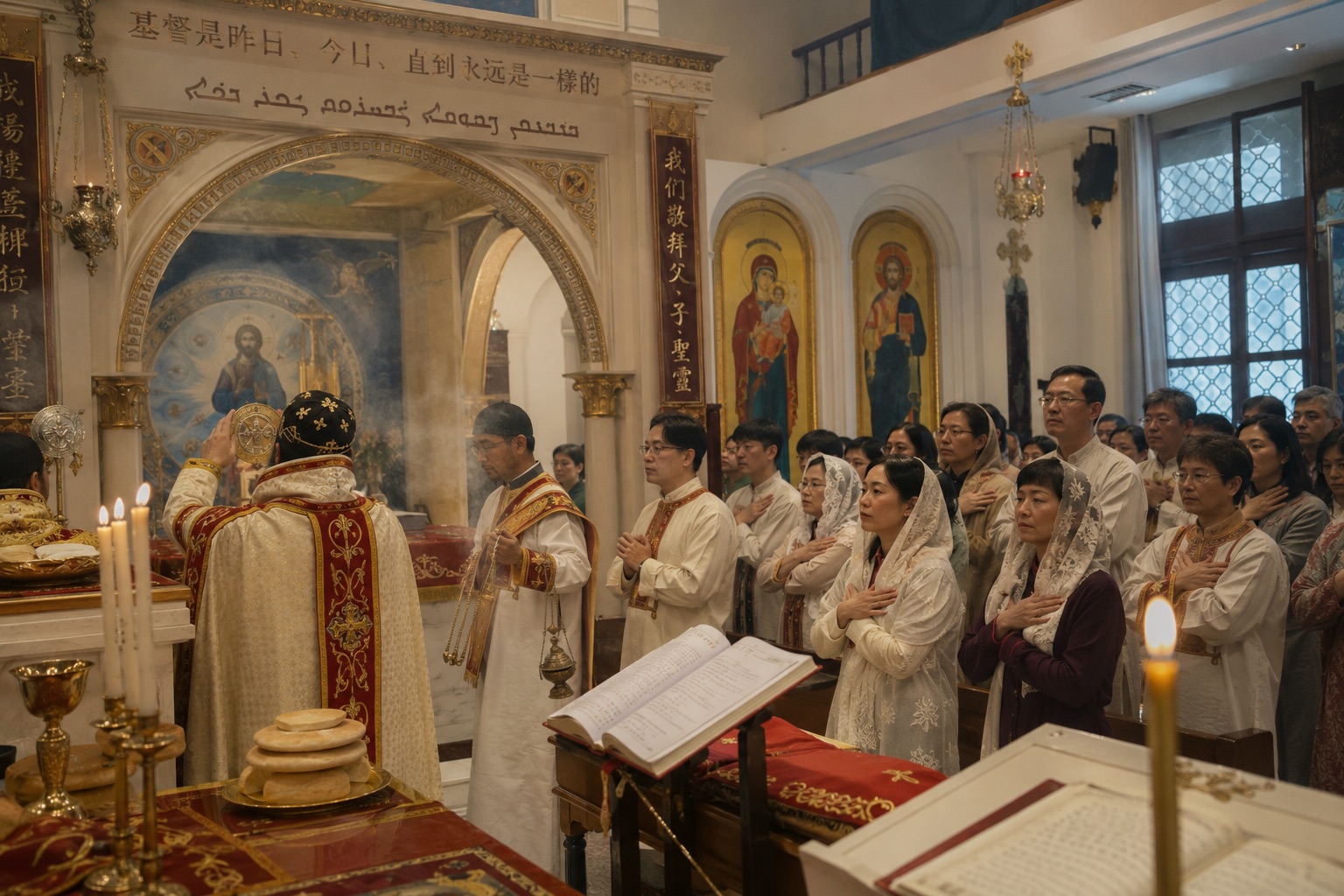
A Sunday mass in Beijing in a counterfactual timeline where Syriac Christianity is the number one religion in China. AI-generated, of course. No such parish exists, yet.
Here we have a case of history shaping historiography. Had the centers of Christian intellectual life remained in Antioch and Edessa, rather than being eclipsed by Constantinople and Rome, these sources might today be treated as foundational rather than as peripheral to the history of the world's largest religion.
Footnotes
-
Syriac is the dialect of Aramaic from the region around Edessa, in what is now southeastern Turkey, that became the great literary and liturgical language of Christianity in the Roman East. Aramaic was the common tongue of the Levant, and of Jesus himself. So the writers in this essay were describing Jesus in a close cousin of his own language, far nearer to it than the Greek of the gospels. From here on I'll simply say Syriac. ↩
-
Translation from W. Cureton, Spicilegium Syriacum (London, 1855). Beware: the version of this passage you will find all over the internet ("He lived on in the teaching which He had given") is F. F. Bruce's much later paraphrase, often misattributed to Cureton. For the scholarly dating debate, see the Utrecht Mara bar Sarapion Project; Annette Merz, David Rensberger, and Teun Tieleman argue for a date shortly after AD 73. ↩
-
Robert Van Voorst: "Jesus is doubtless the one meant." He notes that "king" is not a typical christological title in early Christian literature, and "wise king" is not attested at all, which points away from a Christian author. No serious alternative candidate has been proposed; figures like Judas the Galilean or Simon bar Giora left no laws to posterity. Full disclosure: I cite Van Voorst for the identification, not the dating. He himself favors a second-century date and thinks Mara got his information from Christians. On that we disagree. ↩
-
A consensus with strange holdouts. Bart Ehrman, in his Great Courses series on the historical Jesus, surveys the non-Christian sources (Josephus, Tacitus, Pliny) and never mentions this letter. Asked about it on his blog, he waves it off: no name, therefore not about Jesus. That is a position one can hold, but it deserves an argument rather than a shrug, especially when the scholars who have studied the letter most closely (the Utrecht project of Merz and Tieleman) spent a decade on it and concluded otherwise. Dismissing a debated source is fine. Pretending the debate doesn't exist is not. ↩
-
Strauss developed the idea in the twentieth century but built it largely on Plato, who, on his reading, wrapped criticisms of Athenian democracy in homely analogies: the athlete of the Crito who should heed his trainer and not the opinion of the many, the horse-trainer of the Apology who improves horses while the crowd corrupts them. The mechanism is a two-tier text: the ignorant masses miss what you're saying, while the high IQ people read between the lines. The Straussian reading of Plato is itself contested, but note that Mara doesn't need Strauss to be right about Plato. He only needs prudent men to write carefully under pressure, which is not a contested claim. ↩
-
The c. AD 260 dating is usually credited to Xavier Léon-Dufour; Friedrich Schulthess produced the standard German edition and translation in 1897. Kathleen McVey (1990) also challenged the first-century dating, suggesting the letter may be a rhetorical school exercise. ↩
-
The Doctrine of Addai reached its final form in the late fourth or early fifth century AD. It also contains the far more famous correspondence between Abgar and Jesus himself, which even Ramelli rejects as unhistorical; she defends only the Abgar-Tiberius letters, which sit oddly in the narrative, integrated, in her words, "with difficulty." The study: Ilaria Ramelli, "Possible Historical Traces in the Doctrina Addai," Hugoye: Journal of Syriac Studies 9.1 (2006), 51-127. Full disclosure for the nerds: Ramelli is the field's great maximalist about early kernels in legendary material (she is also the rare scholar who defends a partial kernel of the Paul-Seneca correspondence), and her case here has persuaded few and been refuted by none. She is no dilettante on this terrain, though: she wrote the monograph on Bardaisan of Edessa, and this is her home turf. The reading of the letter as loyalty politics is hers; the strategic reading in this section builds on it. ↩
-
The letter's text is in the Doctrine of Addai (Phillips translation, 1876). Abgar laments the crucifixion, blames the local troublemakers, and declares he would have marched on Jerusalem himself had the covenant of peace with Caesar not forbidden him to cross the border; Tiberius replies that Pilate has already been dismissed with disgrace and that justice will follow once he settles "the trouble with the children of Spain." The dating evidence comes in two layers. Inside the letters: the reply requires that Pilate is already dismissed (late 36), that the "children of Spain" trouble is still unresolved (Ramelli reads the Syriac term not as Iberia-in-Spain but as the Caucasian Hiberi whom Tiberius unleashed on Armenia, an entanglement closed only in mid-37), and that Tiberius is alive (he died March 16, 37). All three coexist for about four months, a needle a fifth-century hagiographer has no obvious way to thread, though a careful one working from Josephus might reverse-engineer some of it, which is why this remains an argument and not a proof. Around the letters: the Abdu and Sennak fossil (the Doctrine's court nobles matching Tacitus's conspirators, see the crisis note), and the correspondence's absence from Eusebius, who claimed to draw on the same Edessan archives as the Doctrine's author, which suggests a different, and not necessarily later, source tradition. ↩
-
Why Judea was the flashpoint, and why Edessa would have heard everything. In 40 BC a Parthian army conquered the Levant and installed its own king and high priest in Jerusalem; Rome invented the Herodian dynasty specifically to reverse it (Josephus, Antiquities 14; Jewish War 1). The trans-Euphrates Jewish diaspora was a multitude "not to be estimated by numbers" (Antiquities 11.133), and its annual Temple tax was marshaled at Nisibis, next door to Edessa, then escorted to Jerusalem by armed caravan (Antiquities 18.311-313). Edessa itself had a community of Jewish silk merchants trading toward Palestine (Segal, Edessa: The Blessed City), and the Doctrine of Addai, in details too incidental to be inventions, has its missionary lodging with "Tobias son of Tobias the Jew, who was of Palestine." Best of all: the royal house of Adiabene, the very next kingdom east, converted outright to Judaism in the AD 30s via a Jewish merchant; Queen Helena lived in Jerusalem and bought Egyptian grain for the city in the famine of the late 40s, her family's golden gifts to the Temple are commemorated in the Mishnah (Yoma 3:10), and two of her kinsmen later died fighting for Jerusalem against Rome (Antiquities 20.17-96; War 2.520, 6.356). Izates of Adiabene is also Abgar's one documented political partner: Tacitus shows the two kings acting in concert in AD 49. A king in Abgar's seat did not need a legend to hear about a Galilean execution; Jerusalem's money, merchants, and politics ran past his gates every year. ↩
-
The family dossier, for the curious. Carrhae, 53 BC: Cassius Dio (40.20-23) has an Abgar of Edessa professing friendship to Rome while steering Crassus into the Parthian trap; Plutarch (Crassus 21-22) calls the same guide Ariamnes, and some modern historians think the "betrayal" was honest advice gone wrong (Segal's verdict: "His situation was, by any standards, unenviable"). Abgar V's own turn is in Tacitus (Annals 12.12-14): in AD 49, "through the deceit of Acbarus," Claudius's Parthian pretender Meherdates was detained "for many days at the town of Edessa" with feasts while the campaign season bled away, then deserted on the eve of battle, in concert with King Izates of Adiabene; the victorious Parthian king cut off Meherdates' ears, mercy enough to let him live, mutilation enough to disqualify him from any throne. Abgar VII feasted the Emperor Trajan at Edessa and had his handsome son dance for the imperial party, then joined the revolt that ended with Edessa sacked; Dio (68.18) states the family strategy outright: Abgar, "dreading both Trajan and the Parthians alike, was trying to be neutral." On the dates: Abgar V's conventional reign (4 BC to AD 7, then AD 13 to 50) rests on Syriac king lists as reconstructed by von Gutschmid in 1887, not on any narrated history; Andreas Luther has proposed different dates; the one hard classical anchor is Tacitus putting an Abgar at Edessa in AD 49-50. ↩
-
The crisis of AD 35-37, source by source. Armenia and the civil war: Artabanus II seized Armenia for his son and sent Tiberius an insolent letter; Rome answered with Caucasian proxy armies and a Roman-groomed Arsacid pretender, while the Parthian nobility, led by the magnate Sinnaces and the court eunuch Abdus, opened a secret channel to Tiberius asking for a replacement king (Tacitus, Annals 6.31-37; Artabanus poisoned Abdus and stalled Sinnaces). Whether Edessa was wired into the plot is unknowable, but the Doctrine of Addai lists "Abdu" and "Sennak" among the nobles of Abgar's court, a correspondence with Tacitus's conspirators first observed by Ramelli. Tacitus never puts these men at Edessa, so the name-match authenticates the archive milieu the legend drew on rather than the letters themselves: either a lucky guess or the fossil of a court that hosted the faction's traffic (the conspirators' pretender crossed the Euphrates on a bridge of boats near Zeugma, beside Osroene, and later fled back the same way; Annals 6.37, 6.41-44). Caveat: Abdu ("servant") is among the commonest Semitic names; Sennak/Sinnaces is the rarer, better match. The war-through-my-backyard nightmare was prophecy, not paranoia: Osroene was sacked under Trajan (116), provincialized under Severus (195), and extinguished by Caracalla (213/214) in exactly such wars. Pilate: fired in late 36 after massacring a Samaritan prophet's crowd at Mount Gerizim, the last of a decade of provocations (the standards affair, the aqueduct riot funded from the Temple treasury, and the gilded shields that earned him a personal rebuke from Tiberius: Philo, Legatio 299-305). He was never judged; Tiberius died in March 37 while Pilate was still en route to Rome, and reliable history loses track of him there (Antiquities 18.85-89). ↩ ↩2
-
The southern war and the alleged meddling. Aretas IV of Nabataea crushed Herod Antipas's army over a discarded wife, the affair John the Baptist was beheaded for denouncing, and Josephus reports that contemporaries read Antipas's rout as divine vengeance for John, which is, note, the exact interpretive logic of Mara's letter applied to a different executed holy man by his own contemporaries (Antiquities 18.109-119). The claim that Abgar fed the war comes from Moses of Khorene (History of the Armenians 2.29), who has Abgar send auxiliaries to Aretas under an Armenian commander, and whose surrounding chapters have Abgar under active Roman suspicion, denounced by the client rulers next door. Handle with tongs: Moses writes at least four centuries later, makes Abgar a king of Armenia, lists his accusers straight out of Luke 3:1, and demonstrably splices heroes into Josephus's stories (he marries Helena of Adiabene to Abgar while citing Josephus, who knew her family and knew better). The one possible trace in a good source: Josephus's unexplained "fugitives from the tetrarchy of Philip" who betrayed Antipas mid-battle (18.114), which Ramelli connects to the tradition, though disaffected locals of the recently annexed tetrarchy remain the more parsimonious reading. If the aid was real, its logic was legible: Tiberius ordered Vitellius to bring him Aretas in chains or bring his head (18.115), and by spring 37 Rome's Syrian legions were marching toward Petra, away from the Euphrates, at the precise moment the Parthian restoration was being decided. ↩ ↩2
-
Book of the Laws of Countries, translated in B.P. Pratten, Ante-Nicene Fathers, vol. 8. Bardaisan (AD 154-222) was a prominent Edessene intellectual. The text names no specific Abgar by number. One complication the reader deserves to know: when Eusebius quotes this same passage in Greek (Praeparatio Evangelica 6.10), the clause about Abgar becoming a believer is absent, and the Syriac survives in a single manuscript of the sixth or seventh century. Scholars in the Walter Bauer and Han Drijvers line have accordingly doubted that any Abgarid ever converted. I find the clause easier to explain as original than as interpolation (a Christian interpolator would surely have made more of it than a ban on ritual castration), but the sentence is contested. ↩
-
See Wilson, I., The Shroud: The 2000-Year-Old Mystery Solved (London: Bantam Press, 2010), plate 15a. ↩
-
Classical Numismatic Group, eAuction 313, CoinID 244455. BMC 13. ↩
-
I did try. In April 2026 I emailed Kenneth W. Harl, the numismatist whose Great Courses lectures have kept me company for many hundreds of miles, with images of the coins and a request for his verdict. As of publication, no reply. If any numismatist reading this can settle the question either way, my inbox is open. ↩
-
Chronicle of Edessa, entry for the year 513 of the Seleucid era (AD 201). The chronicle's phrase is haykla d-ʿidta d-krisṭyane, "the temple of the church of the Christians." ↩
-
I'd add that this interpretation might better explain the later spurious legend of Abgar V corresponding directly with Jesus in the Doctrine of Addai. Under this theory, Abgar V monitors Jesus' execution out of political expediency. The Abgarids sympathize with Jewish Christian exiles in the first century as useful dissidents from a rival kingdom, and possibly even give them refuge in Edessa. As Christianity spreads through second-century Syria, Abgar VIII converts outright. Then in the third and fourth centuries, Edessans mythologize their city's early patronage of Christianity, and gradually "Abgar V wrote a letter about Jesus" becomes "Abgar V wrote a letter to Jesus." This is total conjecture, but it's a tighter explanation than the consensus view, which goes something like: Abgar VIII converted to Christianity, fourth-century Edessans confused him with Abgar V, and then invented the Abgar-Jesus letters whole cloth. ↩
-
The Odes of Solomon, an early Christian hymn collection quite possibly composed in Syriac and quite possibly in the Edessa region, though date, original language, and provenance are all debated. However, a number of serious scholars have argued for a first century date. J. Rendel Harris, who discovered the Syriac manuscript in 1909, dated them to the late first century. Adolf von Harnack went further, arguing the Odes predate the Gospel of John and influenced its author. And James Charlesworth, their principal modern editor, placed them around AD 100. I'd say the mainstream range today runs AD 70-125. I actually don't buy this at all even though it supports my argument. Han Drijvers argued for the third century, and I think he had the right of it. ↩
-
James D. Purvis, The Samaritan Pentateuch and the Origin of the Samaritan Sect (Harvard Semitic Monographs 2, 1968). Purvis's paleographic dating of the Samaritan textual divergence to the Hasmonean period remains the standard reference point; Shaye Cohen of Harvard, whose judgment on these matters far outranks mine, kindly confirmed as much to me some years ago. Yitzhak Magen's excavations at Mount Gerizim have meanwhile dated a Yahwistic sanctuary there to the fifth century BC. For what it's worth, I side with Magen in seeing that sanctuary as the seed of the Samaritan community, but the consensus does not: there is no agreement that a temple on Gerizim already amounts to Samaritanism, and for the schism itself the paleography still carries the weight. ↩
-
Two more examples, for the curious. Luke: a good deal of the case for dating it after AD 70 is that it predicts the destruction of the Temple, and prophecies, the reasoning goes, only get written down after they come true. But it is entirely possible that Jesus said the Temple would be destroyed. Predictions are free; people routinely make some that happen to come true. The Book of Daniel already ties the death of a Messiah to the destruction of the sanctuary; predicting doom for the Temple is exactly what you'd expect from a Messianic movement steeped in Daniel. Paul: all manner of stylometry gets applied to determine which letters are and aren't really his. Scholars count unique vocabulary in one letter versus another, but paper over the fact that vocabulary is topic-mediated: Paul organizing a collection for Jerusalem is not going to sound like Paul arguing about the resurrection. Register, topic, mood, a different amanuensis taking dictation, any of these could explain the variation. A lot of it is tea leaf reading with a spreadsheet. ↩
-
The best objection to this essay is that it is too maximalist: it reads each source in the way most favorable to the thesis, and in ancient history you can make almost anything seem plausible by stacking optimistic interpretations. That objection has real force. But there is a curious asymmetry here: this reading fits the Gospels' own historical narrative better than the standard reconstruction does. The Gospels do not present Jesus as an obscure figure whose importance was discovered only after his death. And this is where the standard reconstruction begins to sound strange to anyone who has ever thought seriously about marketing or the spread of ideas. One of the most successful movements in human history was supposedly founded by a man whose public appeal was confined to a small circle in rural Galilee, and whose movement then somehow crossed linguistic, ethnic, and political boundaries with extraordinary speed after his execution. ↩