Were Ancient People Just NPCs? Or, Flowers for Mr. Jaynes
Back in the 1970s, a psychologist named Julian Jaynes published a book called The Origin of Consciousness in the Breakdown of the Bicameral Mind. Jaynes had noticed something curious: three thousand years ago, people in ancient literature don't seem to have self-awareness. They don't work out decisions. Rather, a god inspires them to go do something. Read the Iliad: Achilles doesn't decide to restrain his anger. Athena grabs him by the hair and tells him to stop. Agamemnon doesn't choose to be foolish. He later explains that Zeus "robbed him of his reason."
According to Jaynes, Bronze Age people weren't aware of their inner monologue. They heard it and thought it was the gods speaking to them. Their theory of mind was completely externalized: courage was put in you by Zeus, poetic inspiration by the Muses, erotic desire by Aphrodite. There was no "I" making decisions. There were just voices.
Fast forward several centuries, and suddenly the picture is very different. We get deep introspection. Socrates is saying all he knows is the limits of his own knowledge. Zhuangzi is trying to figure out if he is really Zhuangzi, or if he's just a butterfly dreaming that he is Zhuangzi. Buddha is meditating and trying to observe mental phenomena without identifying with them. Patanjali is inventing yoga to try to stop the internal monologue. Suddenly, around 500 BC, people have well-developed concepts of self, mind, and self-awareness, and they are inventing vocabularies and frameworks to discuss it.
Now, Jaynes made the right observation but the wrong inference. The so-called Axial Age (roughly 800-200 BC) produces key texts across Greece, India, China, and the Near East that demonstrate a remarkable interest in the self, the mind, and the nature of consciousness. This is a real, quantifiable phenomenon. But his conclusions were wrong. Jaynes thought this was actually a neurological event, that something changed fundamentally in human brain architecture. There is no evidence for rapid neurological reorganization on that timescale, and ancient people who supposedly lacked consciousness somehow managed to build cities, manage irrigation networks, conduct diplomacy, and wage sophisticated wars.
Jaynes was, in some sense, the OG boisterous inquirer. He noticed something curious and obvious, perhaps something people were too polite to really dive into: yes, ancient writers do kind of sound like NPCs. And then suddenly they don't. And he made a brilliant, beautiful thesis around that observation. It was wrong, but it was daring. We respect this.
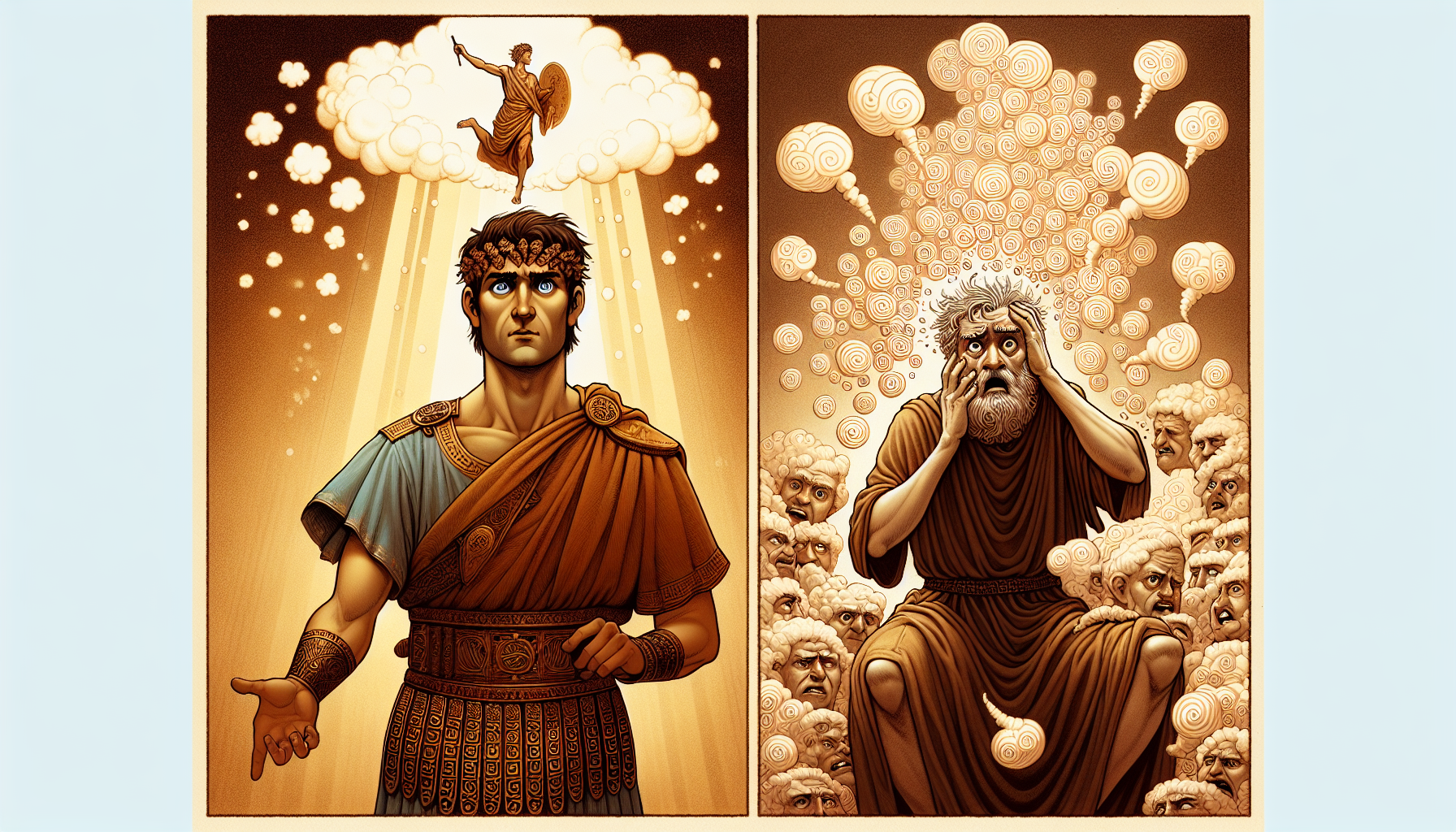
In this essay, we go back in time and retrieve flowers for Mr. Jaynes. We figure out what was really going on. He picked up on something real, and here we try to get to the bottom of it.
The Corpus and the Method
For this post, I pulled 37 ancient texts spanning from the Egyptian Pyramid Texts (c. 2400 BC) to the Canterbury Tales (c. 1390 AD), covering Egyptian, Akkadian, Aramaic, Syriac, Hebrew, Sanskrit, Pali, Tamil, Chinese, Greek, Latin, Old English, Middle English, and Old Norse.
Then I used Claude to do the tagging. The process worked in two phases. In Phase 1, each text was read and every passage touching on inner phenomena (emotions, mental states, decisions, desires, fears, thoughts, self-examination, divine causation of mental states) was identified and extracted into a CSV. In Phase 2, each extracted passage was scored on a 0-5 introspection scale. This produced roughly 3,900 scored passages across all 37 texts.
Is this perfect methodology? No. The scoring was done by an LLM, not a panel of classicists. The text selection is canonical rather than random. The dates of some texts are debated. But the scale is well-defined, the passages are extracted and available for review, and the patterns that emerge are striking enough to be worth discussing.
To test robustness, I pulled 50 random passages from the dataset, stripped out the text names and original scores, and had Claude re-score them blind. The results: 56% exact agreement, 90% within one level, with a correlation of 0.80 between the original and blind scores. Only 5 out of 50 passages had disagreements greater than one level. That's comparable to what you'd expect from human raters on a subjective coding task. Not perfect, but consistent enough that the broad patterns in the data are unlikely to be noise.1
The Introspection Scale
How do you measure something as slippery as "how introspective is this text"? We defined six levels, from fully externalized mental life to full meta-cognition. A higher score is not necessarily better. Patanjali scores near the top of our scale, and his whole project is to make the score go back down.
L0: Externalized psyche. Gods, fate, or spirits directly command or inspire mental states. The agent's inner life originates from outside the self. "Jove put courage into his heart." (Iliad)
L1: Named emotion. An emotion is named but not examined. The feeling is reported like weather, then the text moves on. "Full sad were their minds, and all sorrowing were they." (Beowulf)
L2: Emotional conflict. The agent feels competing impulses, but the conflict is resolved by a god, an external event, or social convention rather than self-reflection. "His heart was divided two ways... Athena came from heaven and seized him by the hair." (Iliad)
L3: Self-address. The agent addresses their own heart, soul, or mind as a semi-autonomous entity. The self splits into speaker and spoken-to. "Endure, my heart; a worse thing even than this you once endured." (Odyssey)
L4: Systematic self-examination. The agent takes their own mental states as objects of sustained inquiry. Not just "I feel X" but "why do I feel X, and what does that tell me about myself?" "To will is present with me; but how to perform that which is good I find not." (Romans 7)
L5: Meta-introspection. The agent observes the process of observation itself. The watcher watches the watching. Knowledge turns back on itself. "How should he know the Knower?" (Brhadaranyaka Upanishad)
The Results
The Axial Age truly saw an explosion of introspection. The Satipatthana Sutta (a Buddhist meditation manual), the Yoga Sutras, Heraclitus, Plato's Apology, and the Zhuangzi all cluster between L3 and L5 in a narrow window around 500-200 BC. Before this window, almost everything sits below L2. The Pyramid Texts (L0.6), the Rigveda (L1.15), the Iliad (L0.9), and Gilgamesh (L1.06) are all overwhelmingly populated by named emotions and externalized psyche.
The jump from the Iliad (L0.9) to the Odyssey (L1.37) to Heraclitus (L4.04) to Plato (L3.40) is the clearest within-tradition trajectory: Greek literature goes from gods-making-all-decisions to "the unexamined life is not worth living" in roughly three centuries.
But isn't Gilgamesh one of the most profound texts in the ancient world? A man raging against death, weeping for his friend, wandering the wilderness in existential despair? It is. And it scores L1.06. The reason: Gilgamesh articulates his fear of death but never examines it. "I am afraid of death. I roam the wilderness." That's named emotion, then action. He doesn't ask "what is it about death that produces this quality of dread?" or "why does the loss of Enkidu undo me in this particular way?" Compare Ecclesiastes, which covers the same territory ("as it happeneth to the fool, so it happeneth even to me; and why was I then more wise?") but actually sits with the question. Emotional power and introspection are different things. The Gilgamesh poet felt deeply. He just didn't feel the need to examine the feeling.
Now here's the surprise: after about 200 AD, the scores mostly drop back down. Beowulf (L1.10), Njal's Saga (L1.06), the Poetic Edda (L1.02), Ephrem the Syrian (L1.30), all score below L2. Even the Pauline Epistles (L1.50), written earlier (c. 55 AD) but anticipating the post-Classical trend, sit below L2. The exceptions are Marcus Aurelius (L3.40) and Augustine (L3.25), both of whom are unusual people: a Roman emperor writing a private philosophical diary and a rhetorician-turned-bishop writing the first autobiography in Western literature. They are also dying breeds. Augustine writing City of God knows that the world that produced him is ending. These are the last inheritors of the Axial Age contemplative tradition before the post-Classical world settles into a literary culture more concerned with emotional conflict, the supernatural, and the drama of salvation than with the systematic examination of one's own mind.
Paul incredibly surprised me, and demonstrates this beautifully. Romans 7, "it is not me but my sinful nature in me," is one of the most psychologically sophisticated passages in ancient literature. I expected it to pull his average way up. But Paul and Christianity writ large are balancing an introspective tradition with a deeply supernatural, externalized model of the self: demons tempt us to evil, the Holy Spirit inspires us to good, God hardens hearts and opens eyes. And thanks to the abundance of such logic across the epistles, these L0 passages outweigh the many highly introspective parts of Paul's self-observation. The result is a composite score that sits at L1.50, which is to say: Paul is one of the most introspective people in the ancient world and one of the most externalized at the same time. He contains multitudes, and the average flattens them. In some sense, Paul heralds the resurgence of a supernaturally mediated, externalized model of the self that will increasingly define Western thought into the middle ages.
And with that, I regret to inform you: the regression line across all 37 texts is basically flat (R^2 = 0.024). Time alone explains almost nothing. Introspection is not a civilizational ramp that goes up and stays up.2 It's more like a spike.
Why the Spike, and Then the Drop?
First, some caveats. Genre and sample bias are real. Most dramatic narrative lives in the L1-L2 range: you can't really write a love story about observing your own consciousness. Our post-500 AD corpus skews toward narrative (sagas, epics, hymns), and if we included more medieval contemplative texts (Buddhist, Manichaean, Christian, or otherwise), the later picture would probably look different. The Axial Age spike is partly an artifact of us including more philosophical texts from that period.
But only partly. The L1-L2 literature exists in abundance from every period, and it's probably more reflective of how people actually think than the heady stuff. More people have always reached for a good story than for a manual on contemplative prayer. The Axial Age philosophical texts are the outliers, not the norm. Which raises the real question: why did the Axial Age produce these outlier genres in the first place?
Egypt had two millennia of literary culture and its best attempt at systematic self-examination was A Man's Dialogue with His Ba (c. 2000 BC), a single extraordinary text that largely remained an isolated experiment. Greece went from the Iliad to Plato in three centuries. India went from the Rigveda to the Upanishads to the Yoga Sutras. Something happened in the Axial Age that created the institutional demand and capacity to produce introspective texts repeatedly, not just once.
The Flow State Hypothesis
I think the answer has to do with a distinction that the data keeps pointing toward: the split between linguistic processing and embodied flow state.
Consider how people spend their time. A modern knowledge worker is either talking to someone, reading something, or writing something. We are linguistic processors nearly every waking hour. We live in our heads. Very little of our time is spent plowing fields, fighting, or performing elaborate rituals.
Now compare that to a Bronze Age scribe, or a medieval knight, or an Icelandic farmer-chieftain. These people could read (or at least the literate ones could), but most of their waking hours were spent in embodied, non-linguistic activity: physical labor, warfare, ceremony, feasting. Their consciousness was predominantly in flow state, engaged with the world through action rather than through internal dialogue.
The Axial Age produced something unusual: a class of people whose entire lives were organized around linguistic self-examination. Greek philosophers debating in the agora, Indian monks meditating in the forest, Chinese sages advising warring kings, Hebrew prophets interrogating the moral failures of their own people. These were people who, by choice or circumstance, had made thinking their primary activity.3
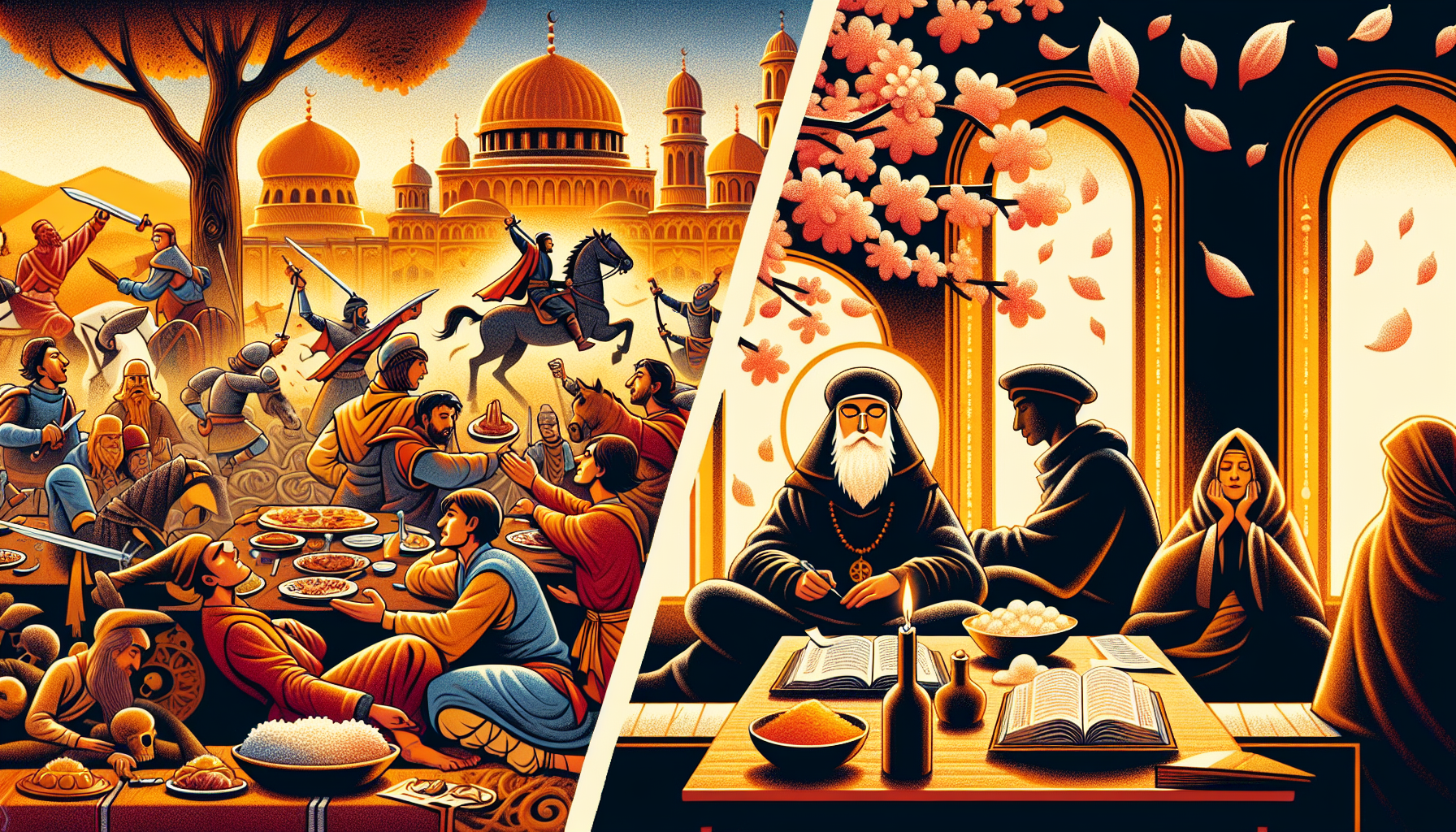
Before the Axial Age, literate elites were mostly scribes, priests, and administrators: people whose literacy was in service of action (recording transactions, performing rituals, managing empires). After the Axial Age, in many cultures, literate elites went back to being people of action: Roman senators, medieval lords, Viking chieftains, church administrators. And their literature reflects it.
This explains why the Norse sagas (composed c. 1280 AD) score lower than the Odyssey (c. 700 BC). It's not so much that medieval Icelanders were less intelligent or less capable of introspection than ancient Greeks. It's that saga culture was a culture of action: farming, feuding, sailing, assembling at the Althing. The saga writers weren't being introspective. They were just out living, and recording the mental life of people who spent most of their time doing things rather than examining their own thoughts. Gunnar sees the beauty of Lithe and decides not to leave, and that's the whole interiority: perception, emotion, decision. No examination. No "why do I feel this way?" He feels it, he acts, the story moves on.
The Irony at the Top
Here's the twist that I think Jaynes would have appreciated: the texts that score highest on our introspection scale are often the ones arguing that introspection is the problem.
Patanjali defines yoga as yogas chitta vritti nirodhah: "the cessation of the fluctuations of the mind." His whole project is to turn the inner monologue off. Buddha's meditation practice is about watching mental phenomena arise and pass without clinging to them, which is a way of systematically disengaging from the discursive mind. Even Heraclitus, who scores L4.04, is mostly criticizing other people for being bad at self-awareness: "other men know not what they are doing when awake, even as they forget what they do in sleep."
The people who climbed highest up the mountain of introspection are the ones who came back and told you the mountain shouldn't be climbed. They developed the most sophisticated technologies of self-examination in human history, and then used those technologies to argue for returning to something like the flow state, but from the other side. The preliterate person was in flow because they'd never left it. The yogi is trying to get back to flow after being trapped in language.
Which suggests that the L1-L2 baseline isn't a failure. It's the normal human condition, and possibly the healthy one. Meta-introspection isn't a permanent civilizational achievement. It's a specialized practice, maintained by specific institutions, that appears when social conditions create a contemplative class and recedes when those conditions change. Like a muscle, it atrophies without use.

What We Do With This
We live in one of those rare periods where conditions favor introspection. We are 24/7 linguistic processors. Almost no one reading this essay spends their day plowing fields or raiding monasteries. It's no surprise that yoga and meditation, those ancient technologies for quieting the inner monologue, are having a moment. The Axial Age thinkers would recognize our problem immediately; they had it too.
The trap, I think, is trying to think your way out of the problem of thinking. The data suggests this does not work. What the data does suggest is that you just need to go out and do stuff. Singing out loud, fighting people, playing instruments, walking in nature, plowing fields. The texts that score lowest on our introspection scale are not produced by lesser minds. They are produced by people who were busy with their hands and their bodies, and who seem, if the literature is any guide, to have been doing just fine.
Appendix
The full dataset of 3,956 scored passages across 37 texts is available for download. Each row contains the text name, passage reference, quote, description, and introspection level (0-5).
Download Raw Data (CSV, 3,956 passages)
Footnotes
-
An objection: aren't we measuring what texts represent, not what people actually experienced? Maybe ancient people were deeply introspective and just didn't write about it. To which I say: introspective people write things down. They blab about it. Diaries, journals, confessions. If you didn't put the work in, it's stolen valor. ↩
-
Within individual traditions, there is a clear upward trend. Greek goes from L0.9 (Iliad) to L3.4 (Plato). Chinese goes from L1.1 (Shijing) to L3.1 (Zhuangzi). Sanskrit goes from L1.15 (Rigveda) to L4.14 (Yoga Sutras). Part of what's happening is that each tradition is building a vocabulary to describe inner experience: languages overwhelmingly borrow from the physical world for mental states (Aramaic hshab, "to count," becomes "to contemplate"; Latin pensare, "to weigh," becomes French penser, "to think"; English reflect is bending light off a surface). But vocabulary alone doesn't explain the spike, because Egypt had the words by 2000 BC (A Man's Dialogue with His Ba reaches L4) and still didn't produce a sustained tradition of introspective literature. Having the words is necessary but not sufficient. ↩
-
I'm aware that in some sense I'm weaseling out here by saying "people in this period were interested in introspection, so they made texts about it." Why that interest arose is a question that probably deserves its own book. My basic theory, which I hope to develop elsewhere, is that the Bronze Age was a world of order vs. chaos: people believed they had a formula that worked (cosmic order, divine kingship, ritual maintenance of the world), and the job of civilization was to uphold it. After the Bronze Age Collapse and into the Iron Age, people remembered the old order but were no longer sure it was the right one. The question shifted from "how do we maintain order?" to "how do we know what good order even looks like?" That's a question that demands introspection, because you can't evaluate competing visions of the good without examining your own assumptions about what "good" means. The ethical and philosophical flowering of the Axial Age follows from that shift. Greek philosophers, Indian monks, Chinese sages, and Jewish prophets were people who had, by choice or circumstance, stepped out of the flow state and into more permanent linguistic processing mode. They didn't just care about upholding order but about upholding a just order, and that required sitting with questions that the Bronze Age had been less interested in exploring. ↩